


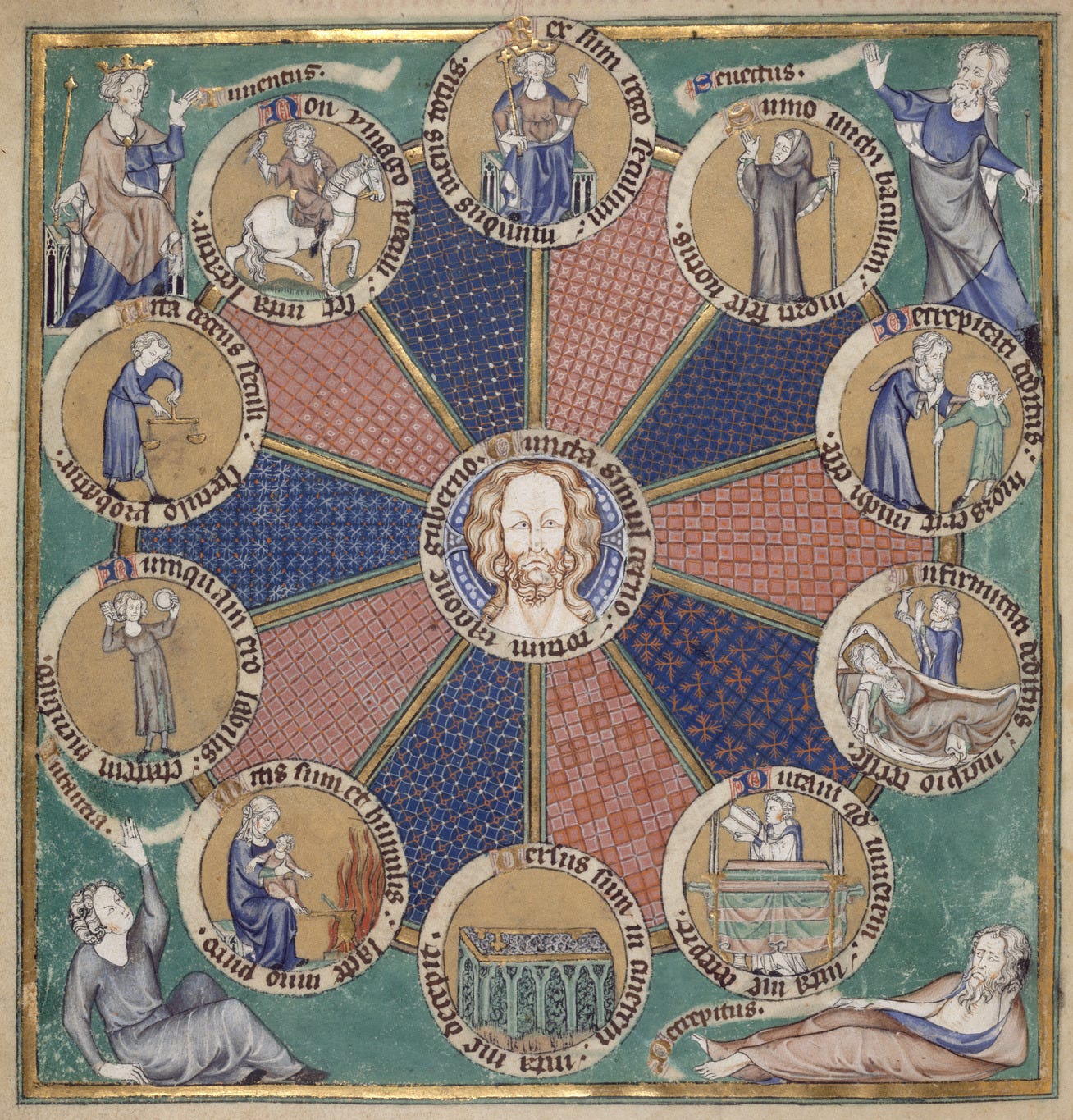
Some say that a human life can neatly be divided into thirds. Assume you’ll live to 90 — a healthy lifespan, slightly above most life expectancies — and you get three thirty-year periods. From birth to 30 is your youth; from 60 to your death is old age. In the middle, from 30 to 60, you get three decades of midlife.
This is different from the typical definition of “middle age”, which usually refers to the period from 40 to either 60 or 65, but the elegance of the three thirds is attractive. (Also, if the middle age starts at 40, what are you at 39? A young adult? Come on.) The problem with this theory that it doesn’t really work. Maybe it did in the past, back when most people at 30 would be expected to already have a career, a spouse, and at least one kid, and when the left half of this meme was true:

But today, among educated Westerners at least, who spent a lot of their youth in universities and/or flailing around while trying to figure out a career, there’s no denying that 30 feels young-ish, spiritually belonging more to your twenties than to the mature part of your life. And so does 31. And 32. And 33, maybe? 34, if we stretch…
And then we get, like I do today, to 35 years old.
At 35, half of the fourth decade of your life is over. It becomes increasingly difficult to pretend you’re young. Your body is starting to show it, in subtle but noticeable ways. You have several years of experience at whatever job you’re doing, are probably making decent money, and are unlikely to totally switch careers in the future. You may or may not have kids, but you likely either are in a long-term relationship that has gone on for a while, or you have experienced at least one such that has ended. You have, in sum, a history.
So perhaps we can revise the theory of thirds: Youth is from 0 to 35, midlife is from 35 to 70, and old age is from 70 to whenever you die, hopefully at least 105. (This scheme also works better than the other for the second transition: I do hear from people who are in their sixties, like my parents, that they don’t feel old, even though they have a lot of the markers of old age, like being retired and living an increasingly insular life in their little house in the countryside.)
Under this theory, today I bid goodbye to my youth and welcome the middle age. I feel okay about this, in a way that I didn’t at 30.

Because the title of this post is an easy pun with the name of a historical period, I entered a bit of a rabbit hole about medieval conceptions of the stages of life.
An influential categorization was apparently that of Isidore of Seville, who lived at the very beginning of the Middle Ages (560-636). He is known for his encyclopedia Etymologiae, in which he gave the following stages:1
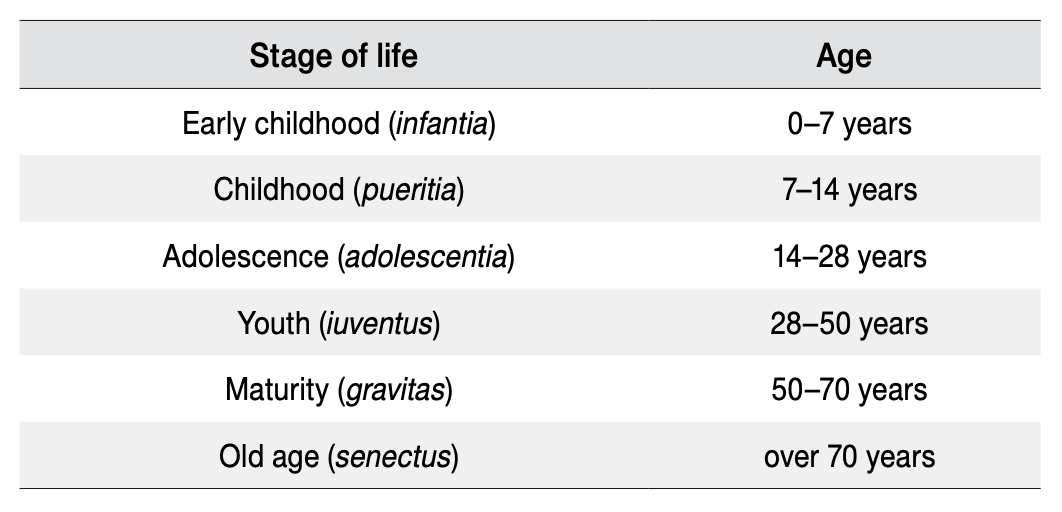
According to this, I’m still in the first half of iuventus, youth. I’m very okay with that. Also notable is the pretty long adolescentia, until 28 years old, which doesn’t feel out of place in the 21st century at all. In fact the whole table feels surprisingly modern, and makes me question the received wisdom that adolescence is a recent invention or whatever.2
From what I understand, Isidore’s scheme is based on St. Augustine, who mapped the six stages of life to six ages of humanity, thus indicating that I am not the first person to think of this. However, in St. Augustine’s time (354-430), the Middle Ages hadn’t started, so he couldn’t use that. Instead he came up with the Six Ages of the World, which were based on the Bible and were the main way people conceptualized history during late antiquity and the medieval period:
Infantia: Adam to Noah and the flood (perhaps 2300 BC)
Pueritia: the flood until Abraham (roughly 2000-1800 BC)
Adolescentia: Abraham to King David (10th or 9th century BC)
Iuventus: David to the Babylonian exile (6th century BC)
Gravitas: the Babylonian exile to Christ (~1 AD)
Senectus: Christ until today and/or the Last Judgment (date unknown)
(There is also a secret seventh age, eternal rest with God, corresponding to the seventh day of the week, sabbath. But this doesn’t quite map to either an age of man or a historical period.)
Augustine’s scheme is explicitly not meant as a practical guide for how to live your life. He doesn’t even give age ranges. And the lengths of the eras are of wildly varying lengths, with young adulthood being one of the shortest. Augustine was making some kind of cool theological analogy, not trying to help you deal with your midlife crisis.3
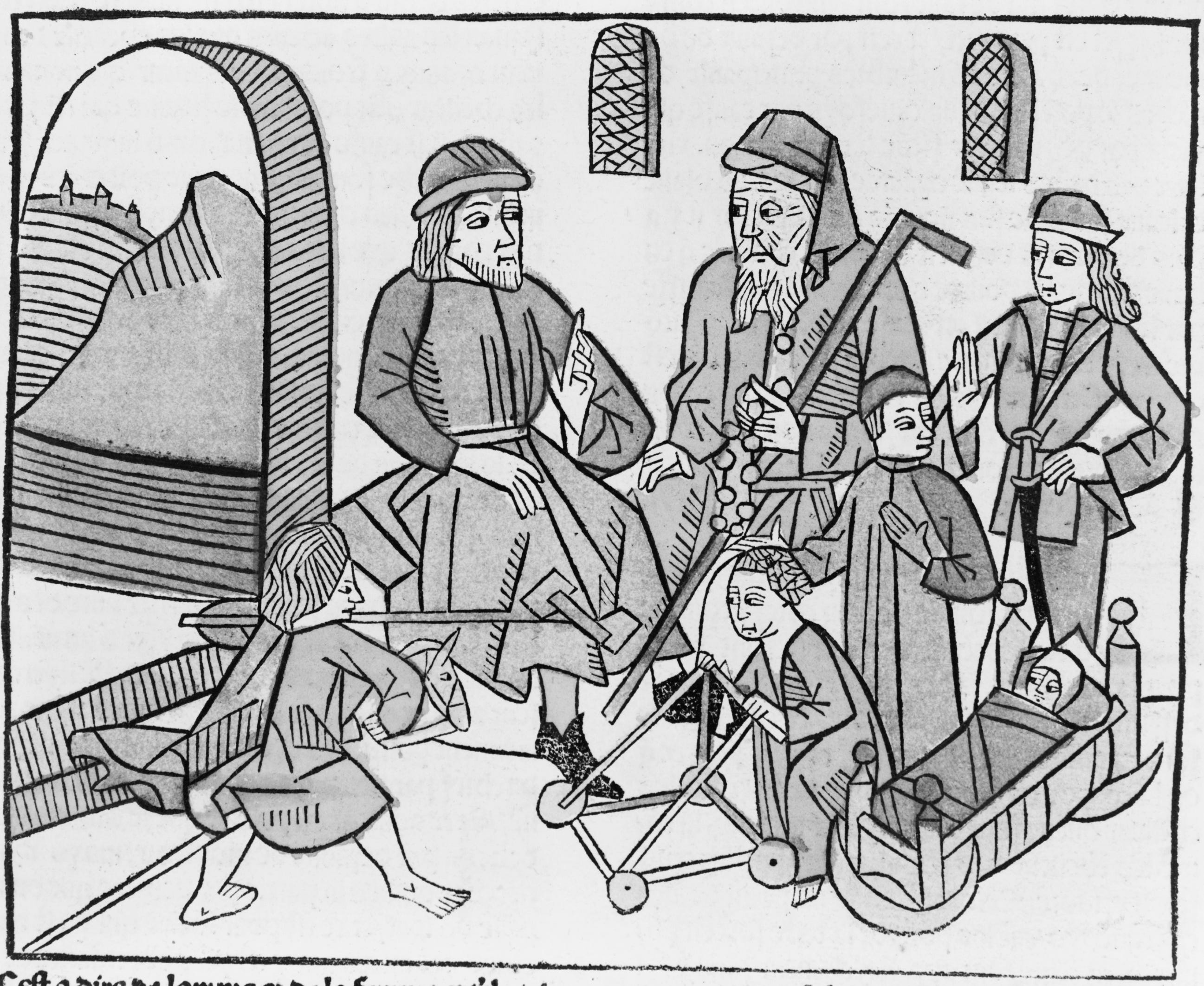
Some other ancient authors whose age categories were influential in the Middle Ages, at least when their texts reentered Western Europe from the Arab world, were Aristotle and Ptolemy. Aristotle divided the ages of man into three, like our theory of thirds above, except his stages weren’t equal: there was youth, prime, and old age. Prime was a short period where the excesses of youth (hope and passion) and the excesses of old age (cynicism and caution) balanced out. Ptolemy, in keeping with the theme of being Ptolemy,4 matched the ages of man to the seven planets, which at the time comprised the Moon and Sun:
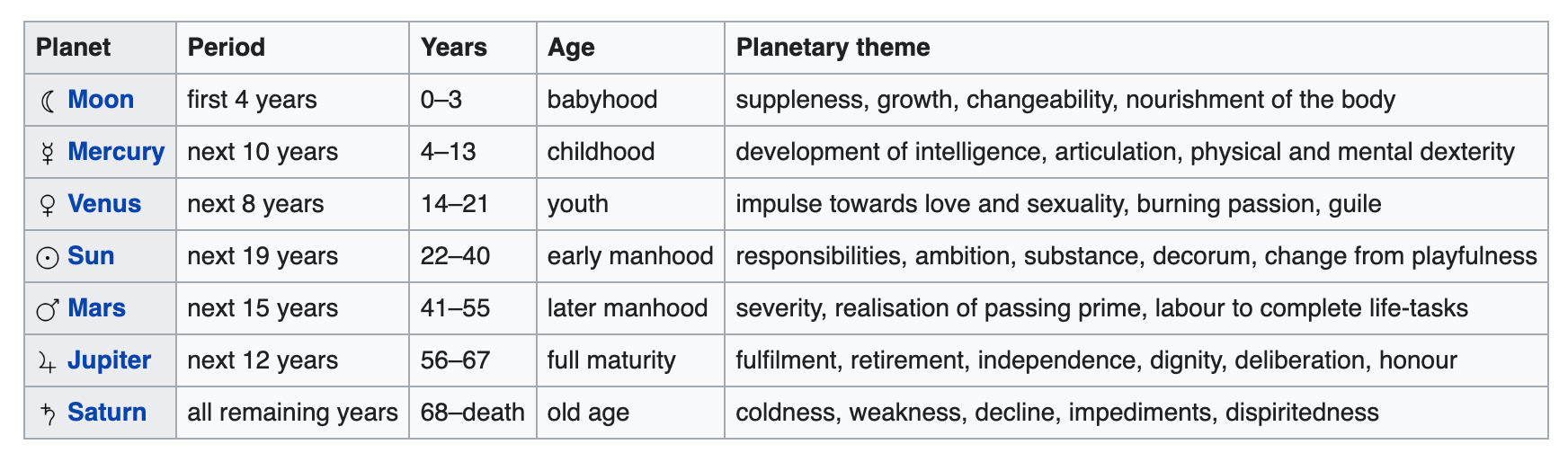
According to this I’m in the Sun phase, full of responsibilities, ambition, and decorum. Sure. The middle age according to the modern definition is associated with Mars, which sounds combative and difficult.
Various later medieval intellectuals had stuff to say about ages, like Hildegard von Bingen or Avicenna, but most didn’t give explicit age ranges. One exception is Philip of Novara, an Italian writer and jurist who lived in the crusader Kingdom of Jerusalem and Cyprus. He wrote, in the variant of old French that was spoken in the crusader lands of the Eastern Mediterranean, Des IIII tenz d'aage d'ome, translated to modern French as Les Quatre Âges de l'homme, and apparently never translated to English. Philip didn’t know Latin and wasn’t trying to build on his intellectual predecessors to make some hare-brained analogy to history or planets. He just wanted to impart the wisdom accumulated throughout his life by writing a book in vernacular language a few years before his death, circa 1265-1270. Philip divided a notional 80-year life into four quarters of twenty years:5
Childhood, ages 0-20, “a period of learning from one’s elders”
Youth, ages 20-40, characterized by “love, sin and folly, and of impetuous acts of violence and revolt”
Middle age, ages 40-60, which is “when a man develops his greatest virtues and accomplishes his greatest achievements” while for women it is “a period of even greater folly than youth”6
Old age, ages 60 until death, “a period granted by a benevolent God to give man time to ‘recall adequately God’s kindness and the debts he owes to his Creator.’”
What’s cool about this is that it seems to be one of the first occurrences of the phrase “middle age” (or moyen âge in French)7 to describe a part of a human life. It also happens to correspond almost perfectly to the modern concept of middle age. Perhaps four or five twenty-year periods are a better scheme than thirty- or seven-year periods, actually, and our man Philip had everything figured out in the 13th century (except for that one quote about women).

If Philip of Novara may have coined the phrase “middle age,” the phrase “Middle Ages” didn’t come until quite a bit later. The direct Latin equivalent medium aevum8 is recorded only in 1604, well after the end of the Middle Ages. There were precursors: Petrarch already thought in the 1330s that he was living in a “dark age,” and media tempestas, meaning “middle season”, occurs to refer to the period after antiquity soon after the “official” end of the medieval period, by Giovanni Andrea Bussi in 1469. Eventually Pierre de Marca gave us the French term, moyen âge, in 1641, centuries after Philip of Novara had used it to refer to a stage of human life.
You’d expect that the obvious near-sameness of the two phrases would have then spurred lots of analogies by modern wannabe St. Augustines. Apparently not. Various intellectuals, such as Oswald Spengler, have likened civilizations to living organisms with specific life cycles, but almost nobody has commented on the middle age / Middle Ages thing.9
I would wager a guess that this is because the analogy works poorly. The Middle Ages in Western Europe are usually, rightly or wrongly, seen as a period of not much going on, following a decline from the splendor of antiquity. The middle age in a human life has an element of decline, yes, but is more importantly a time of strength, wisdom, productivity, achievement. If I had to match it to a historical period, it might be… right now? We have a mature civilization, powerful and generative, but also one that does not quite believe in future improvement anymore — just like a 55-year-old with a nice career behind her but not much more to expect from the future. The earlier parts of the modern era (1500-1900?) might then correspond to young adulthood, and the medieval period to some kind of long adolescence crisis after the promising childhood of antiquity.
So middle age and the Middle Ages have little in common, other than being in the middle of other things. And really, this whole genre of analogy is flawed: civilizations don’t have a lifespan, despite what Spengler may have thought. Human ages are finite and predictable; civilizational ages aren’t. St. Augustine’s metaphor with biblical ages is irrelevant today, and it seems silly to think that we’ve been in “old age” for the entire Common Era. Had he known what was coming, he would have proposed a different breakdown.
And my suggestion that we’re in our middle-aged phase now might prove totally incorrect, depending on future events. Perhaps we’re still in our societal childhood, and the future will be so much grander and more “mature” than everything in our past. Or perhaps, as Anthropic’s CEO Dario Amodei has suggested, our current development of AI corresponds to our technological adolescence.

Let’s end with Dante, because Dante turned out to be almost on-the-nose relevant.
Dante Alighieri was one of the greatest Italian poets, medieval poets, and poets in general. He was born in Florence in 1265, right around when Philip of Novara was writing his four ages and/or dying. Like Philip, he suggested a division of ages in a poem of his book Convivio:10
Returning to the proposition, I say that Human Life is divided into four ages or stages. The first is called Adolescence, that is, the growth or increase of life; the second is called Youth, that is, the age which can give perfection, and for this reason one understands this Youth to be perfect, because no man can give except of that which he has; the third is called Old Age; the fourth is called Senility, Extreme Old Age, as has been said above.
Adolescence and Old Age each last 25 years; in the middle is Youth, which lasts twenty.
Of the second, which is the height of our life, the time is variously taken by many. But leaving that which philosophers and medical men write concerning it, and returning to the proper argument, we may say that, in most men in whom one can and ought to be guided by natural judgment, that age lasts for twenty years. And the reason which leads me to this conclusion is, that the height or supreme point of our arc or bow is in the thirty-fifth year; just so much as this age has of ascent, so much it ought to have of descent; and this ascent passes into descent, as it were, at the point, the centre, where one would hold the bow in the hand, at which place a slight flexion may be discerned. We are of opinion, then, that Youth is completed in the forty-fifth year.
Thus Youth is from 25 to 45, with a peak at 35. This turns out to be the exact middle point of a typical human life of 70 years, as defined in the Bible (Psalm 90:10). I suppose this matches my three 35-year periods scheme pretty well, adjusted for more longevity after 70. Sadly, Dante himself would not get his biblical time allotment: he died at age 56, of malaria.
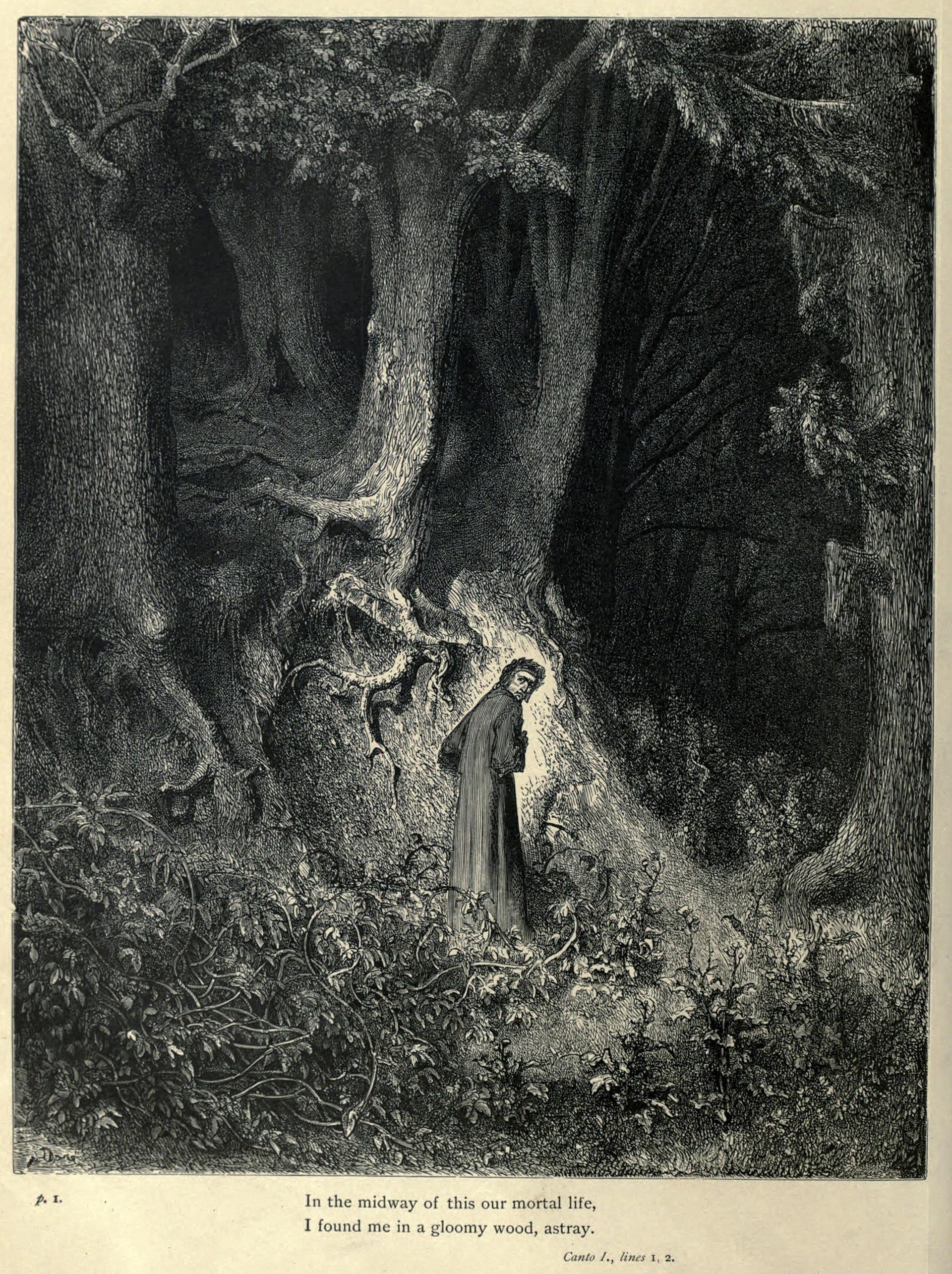
What did Dante do at his peak? He wrote plainly about this, in the three first lines of his Divine Comedy, one of the greatest works of literature of all time:11
Midway upon the journey of our life
I found myself within a forest dark,
For the straightforward pathway had been lost.
The Divine Comedy was written in 1308-1321, but it is set in the spring of 1300, when Dante was 35.12 And it reads a bit like a midlife crisis. Right at the middle point of life, Dante tries to find his way. Here we are, in one of the most famous poems of the Middle Ages, dramatizing the middle age and all the worries and disorientation that come with it.
I turned 35 today. I don’t know if this is really a turning point, but it does feel more significant then most of my past birthdays. Maybe I should celebrate by reading the Divine Comedy.
And in which, apparently, he helped standardized the usage of periods, commas, and colons. The more you know!
The scheme also comes close, but doesn’t quite match, a division in ten periods of seven years, which is found notably in a poem fragment attributed to the Athenian statesman Solon (c. 600 BC).
Deliberate anachronism: the midlife crisis was invented in 1957 and published in 1965 by Canadian psychoanalyst Elliott Jaques, based on his study of the lives of great artists.
As in, his most famous thing is most likely Ptolemaic geocentrism, i.e. being one of the most influential voice on astronomy until Copernicus
The quotations are from a blog post by a historian of the crusader kingdoms: “A Man for All Seasons: Philip de Novare”
Our blogger, Dr. Schader, points out that “This sounds remarkably like a man speaking from bitter experience and then generalizing to an entire sex!”
Note however that the contemporary French term for middle age is âge mûr (ripe age), not âge moyen.
Medium aevum is the source of the adjective “medieval.”
The closest, apparently, is a 1957 introduction by Dorothy L. Sayers to the medieval epic The Song of Roland: “And so Roland rides out, into that new-washed world of clear sun and glittering colour which we call the Middle Age (as though it were middle-aged) but which has perhaps a better right than the blown summer of the Renaissance to be called the Age of Re-birth.”
Quoted from the Convivio on Project Gutenberg
Quoted from the Divine Comedy on Project Gutenberg
Though we know his date of birth through deducing it from the Divine Comedy, so don’t take this as more significant than it should.
Thanks for this. As someone who recently turned 35, I found this extremely relatable. And a bit sad...
Merci Étienne! Un autre excellent texte!
Le moyen âge loin d’être une période sombre! Abattons ce préjugé!
Je suis fascinée d’apprendre que déjà au moyen âge, on parlait d’adolescence. J’avais aussi la vague notion que c’était une « invention » plus moderne.
Comme division de nos vies, je trouve que les 7 parties sont plus précises et intéressantes que seulement 3 ou 4 parties.
C’est peut-être parce que on ne se rappelle pas de sa petite enfance qu’on a de la difficulté à concevoir des divisions de cette partie de la vie. Si on observe les enfants, on voit un monde de différence entre 3 mois et 6 ans, comparé à entre 30 ans et 40 ans par exemple.
Plus tard, Erik Erikson écrit qu’il y a 8 stades du développement psychosocial. Au lieu d’être des périodes temporelles, ce sont des étapes à franchir. C’est loin d’être parfait comme théorie, mais j’aime l’idée que certaines personnes bien qu’ils évoluent physiquement restent parfois « immature » au niveau psychologique. Bref!
Bonne fête! 🥳