


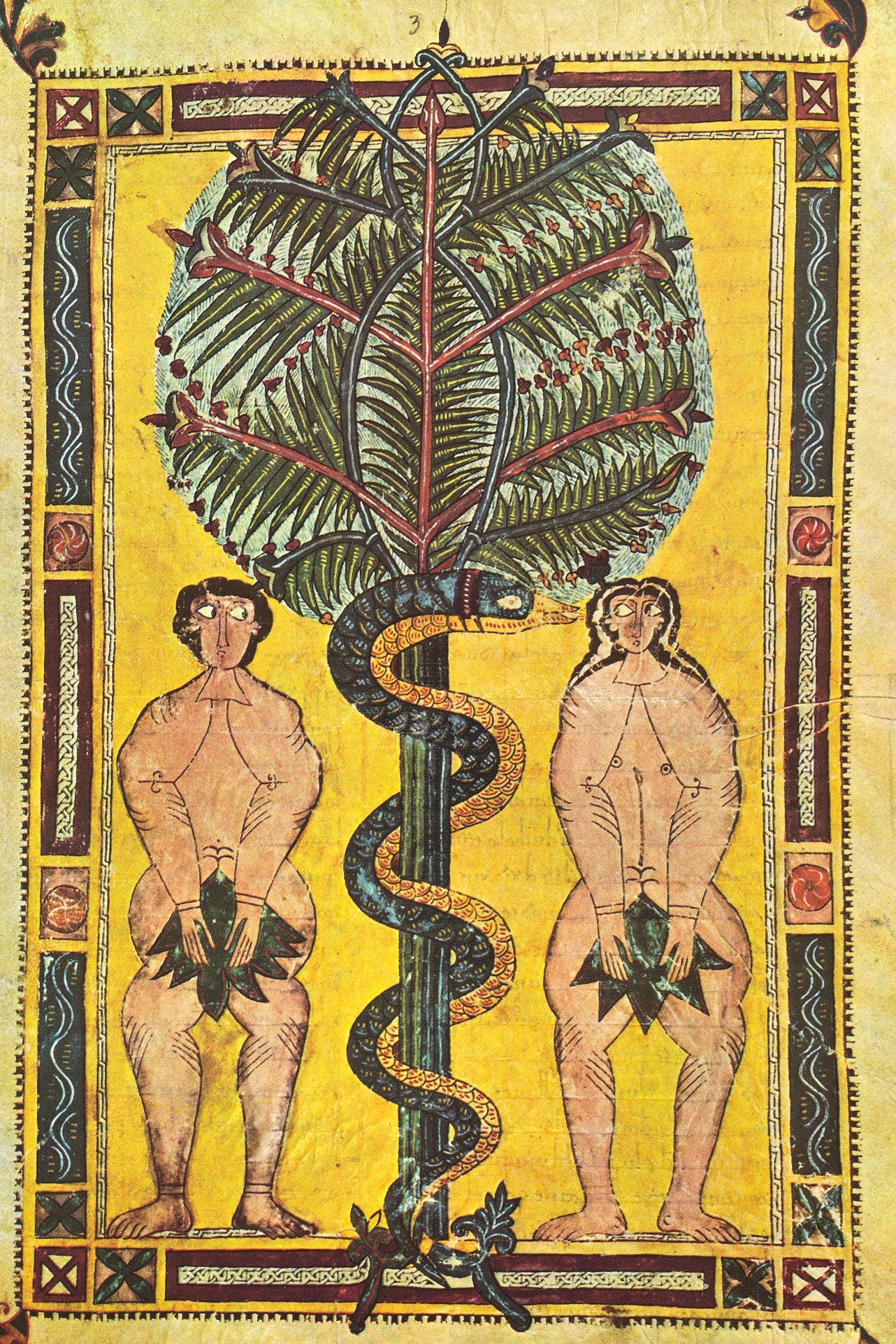
Once upon a time, our ancestors invented sex. We don’t really know why, but it probably had to do with the benefits of combining genetic material in novel ways, accelerating evolution.
At the moment of sex’s invention, the individuals probably all looked the same. Any of them could have sex and reproduce with any other. Soon enough, however, evolution found that it made sense to specialize, and our ancestors diverged into two categories. One of them had large gametes — reproductive cells — and produced only a few of them, since a single gamete required a significant amount of resources. Billions of years later we would call these gametes “eggs” and the category, “female.” The other category had small gametes, and produced a large number of them, only one of which was needed to fertilize the big egg. Now we call that “sperm,” and we call the category “male.”
This happened roughly two billion years ago. Between then and now, there has been a lot of time for evolution to improve upon this system. Along with the size of their gametes, females and males diverged in a million other ways across the various kingdoms of plants, fungi, animals, and everything else. One of those lineages is ours, and during the evolution that led to chordates, vertebrates, lungfish, tetrapods, amniotes, mammals, primates, great apes, and finally humans, our genome picked up quite a few male–female differences. The anatomy of our reproductive organs differs, of course. And then there are several secondary sexual characteristics, such as facial and body hair, voice pitch, the shape and size of breasts, and average height and muscle mass. There are probably deep psychological differences that come from our genes as well.
Evolution also gave us brains and language, and we used those to invent culture, which in turn offered an alternate substrate for evolution. Humans now vary not only according to their genes, but also according to their memes: behaviors, customs, communication patterns, technologies, beliefs, values. Memes propagate differently from genes, but like genes they are both causes and effects of sexual reproduction in many cases. Social norms around sexual behavior govern how and when we have babies; meanwhile we often adopt the memes of our parents, including language, religion, and cultural habits of various kinds.
As a result, cultural evolution has created a whole host of male–female differences beyond the biological ones. Culture is fuzzier than genetics, so those cultural male–female differences are subject to more change over time, or between different human societies. But at any given point — for example, the West in 2026 — we can recognize traits as conventionally more feminine or masculine. The custom of wearing short hair is more masculine; the custom of wearing dresses is more feminine.1 Ambition and aggressiveness are typically registered as masculine psychological traits, while care and agreeableness are more feminine. Pink is a strongly feminine color; blue is a mildly masculine one.
A quick attempt at writing two long lists of such traits, a feminine and a masculine one, lives here. It covers everything from anatomy to sexual preferences to psychology to household responsibilities. There is no cosmic truth or moral judgment in these lists: they are only descriptions of whatever genetics and culture came up with.
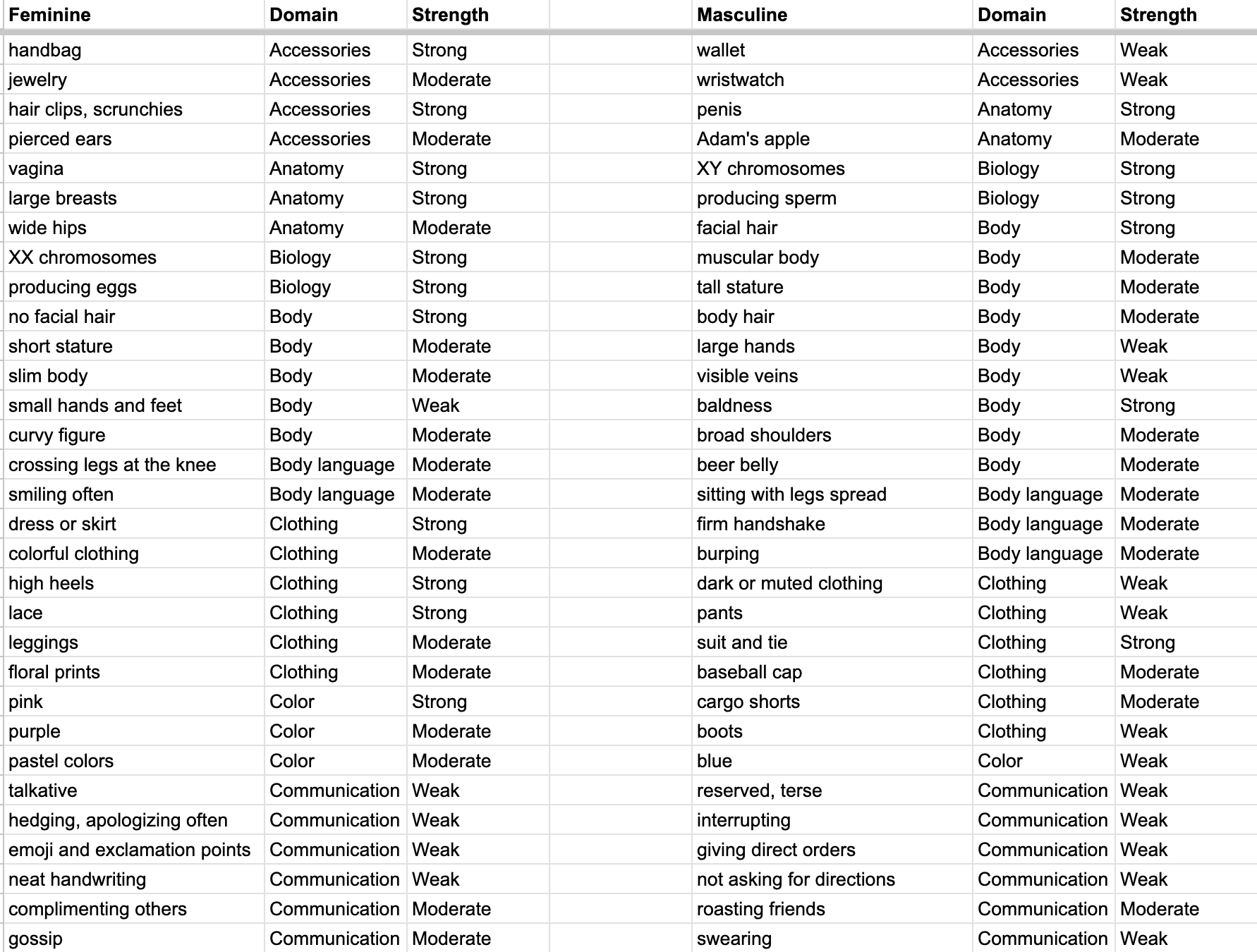
Of course, there are large numbers of traits that don’t fit either list because they don’t have any gendered associations. But the lists contain a lot, and even traits that seem neutral sometimes turn out to have a gendered dimension upon examination. In discussion with friends, offered the example of hair color, which, since it is naturally evenly distributed between men and women, seems like it should have no gender associations. My friends pointed out that blond hair is generally seen as (weakly) feminine, which I now agree with: women and effeminate gay men pick it as an artificial color more often than straight men, and there are a lot of media tropes involving blond women.2

To make sexual reproduction work smoothly, evolution (both genetic and cultural) has a double task with these lists.
The first task consists of clustering people to one list or the other. It is harder to pair people and produce offspring if it’s ambiguous which of the large-gamete or small-gamete categories they belong to. Thus gendered biological traits tend to derive from the same few genes and physiological mechanisms. One hormone, testosterone, is at the source of male reproductive organs, body hair, higher muscle mass, and so on. Gendered cultural traits tend to be enforced by various behaviors and norms: most people want to belong to one list more than the other.
The result of this task is a person’s sexual or gender identity.3