


Before its key role in nuclear fission was discovered in 1938, uranium was a minor element, little more than a byproduct of more valuable substances. It was first identified in 1789, the year of the French Revolution, by Martin Heinrich Klaproth in Berlin. Klaproth named the new element after the planet Uranus, itself recently discovered and named after the Greek Titan god of the sky. But there was nothing sky-like about uranium. Klaproth had found it in a mineral called pitchblende, a German word that can roughly be translated as “black ore that looks like it contains useful metals but doesn’t.”
Glassmakers in the Czech lands, the only place where pitchblende was mined, found a modest use for uranium. You could, it turned out, use it to give glass a fancy yellow or green tint. Thus was born uranium glass, at first a minor luxury good, and then a mass-produced commodity in the 1920s and 1930s, after uranium became super cheap as a waste product of the exploitation of pitchblende for another purpose (more on that later).
But the heyday of uranium glass wasn’t meant to last. Soon enough, the value of uranium shot up, after chemists and physicists found that it could serve as the main ingredient for the most devastating bombs the world had ever known, as well as the fuel for a new type of power plant. During World War II, most uranium ore was used up by the Manhattan Project or the German nuclear program, and after the war it made no sense to use it as a mere colorant, except on a tiny scale by a few artisans. The result is that today, uranium glass is found primarily as an antique from the Depression era.
(It also didn’t help that it’s radioactive, though fortunately not at dangerous levels. Still, people recommend not drinking from it, just in case.)
All of this is to say that I recently acquired my first uranium glass! A nice cream and sugar set, found at my local church-basement vintage market:
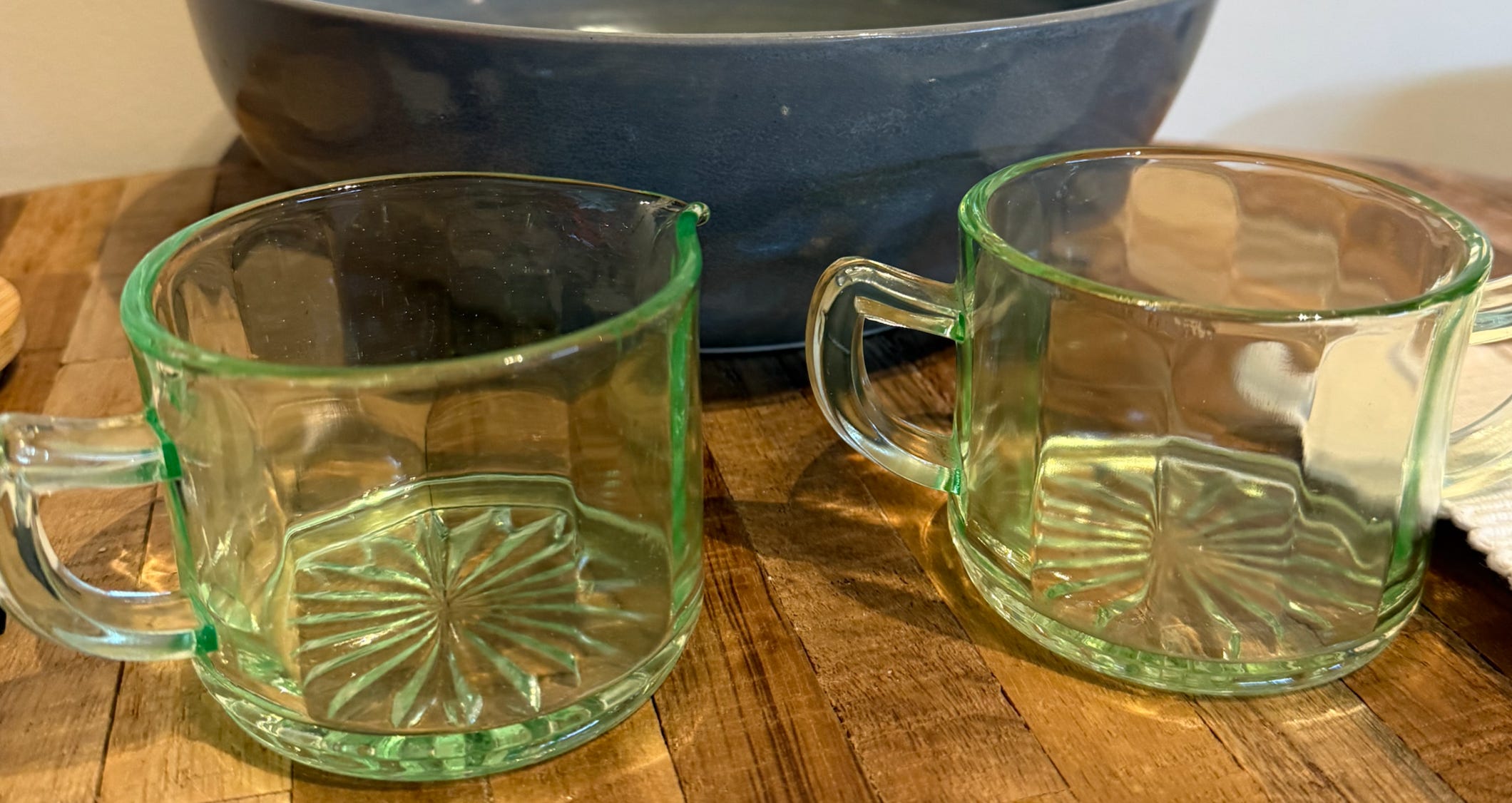
Cool, right? But it gets even cooler when you know that under the right circumstances, it glows. Amazingly, otherworldly so. The right circumstances, specifically, are 395 nm ultraviolet light. So I bought a small black light on Amazon, allowing me to take pictures such as this:
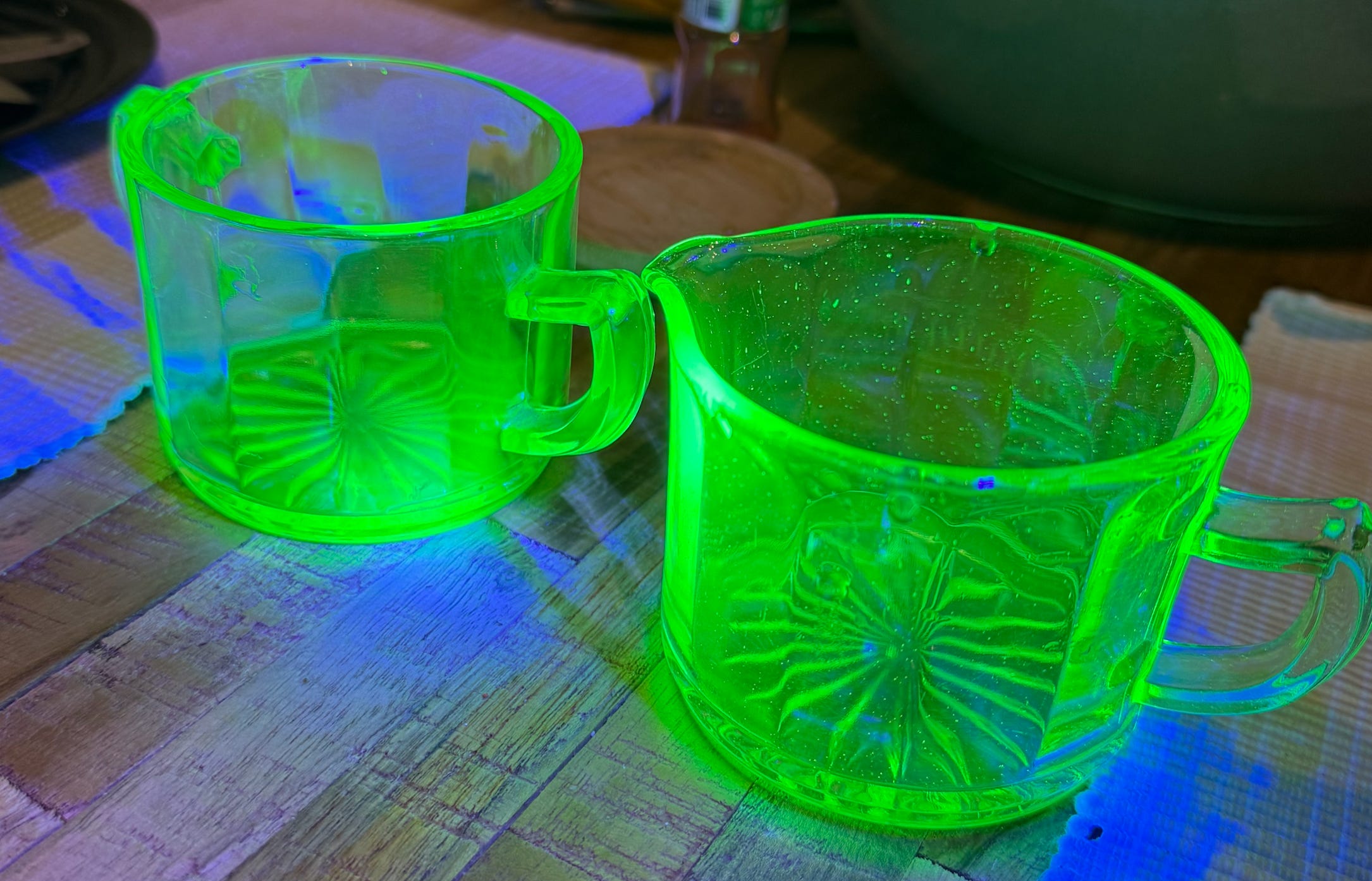
Isn’t it the coolest thing ever??? I’m so happy I have my little freaky, radioactive, green antiques next to my desk. Sometimes, while I work, I just randomly flash my black light on them to bask in the coolness of the glow for a few seconds. (Not any longer, or my eyes start feeling weird from the UV.)
But then I did what I often do: I read up about uranium glass online. And what I learned troubled me.
You see, it turns out that the green glow of uranium glass under ultraviolet light:
has nothing to do with radioactivity;
probably has nothing to do with popular culture depictions of uranium (and other radioactive materials) as green, glowing, and dangerously toxic.
It feels like a joke. It’s inelegant. Uranium glass has exactly the kind of color you’d expect from decades of cartoons and video games showing radioactive substances, and it’s likely just a big coincidence. I am not happy about this. But at least I learned a lot of interesting facts in the process, and so will you.
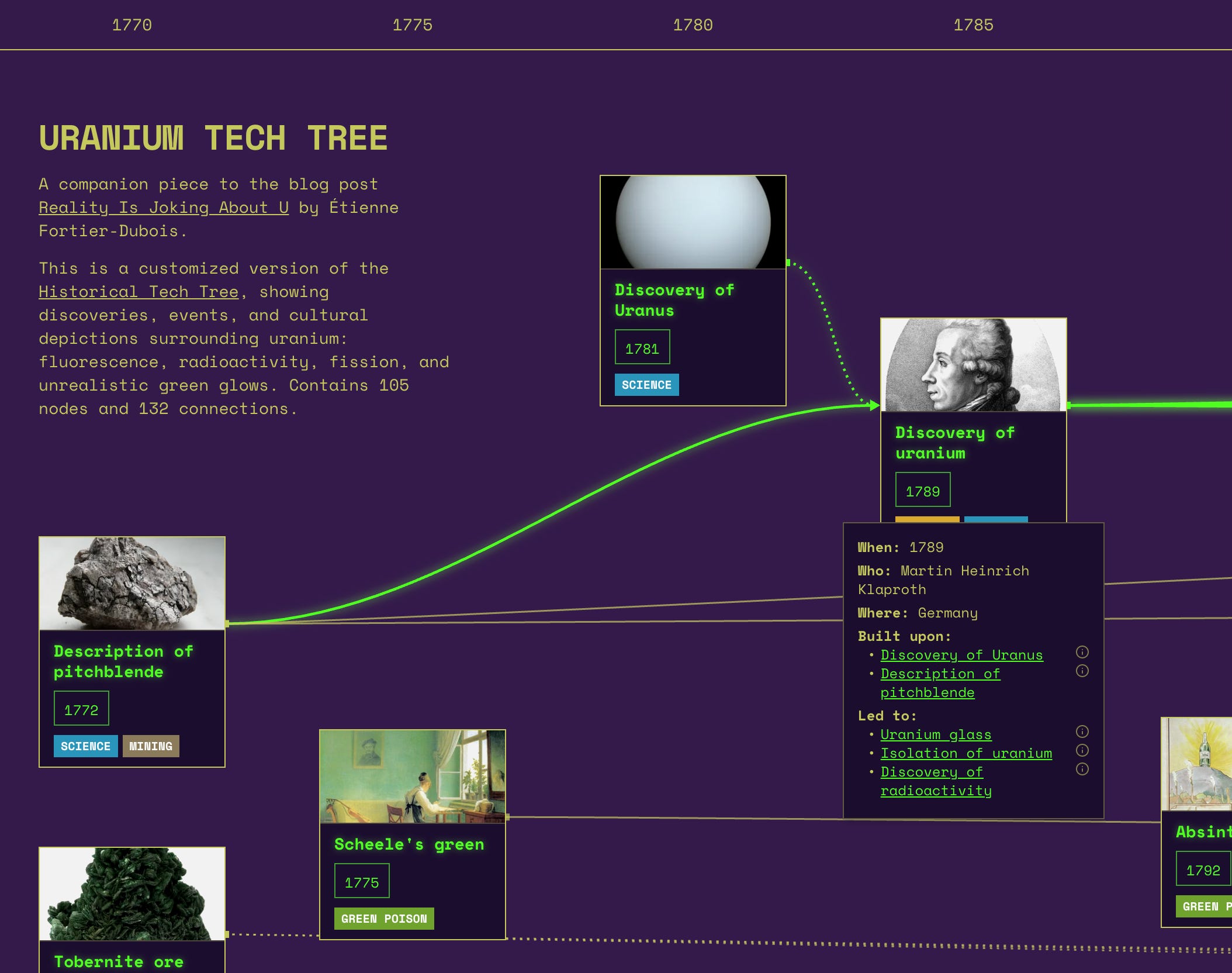
Note: As a companion visualization to this post, I made a mini tech tree representing the events, discoveries, and cultural depictions discussed in this post, and more! Click this link to explore it.

First let’s get the chemistry and physics out of the way.
Atoms are made of a nucleus surrounded by electrons. For example, here is a single atom of uranium-235, showing 92 protons (+) and 143 neutrons (neutral) in the nucleus, for a total of 235 nucleons. Around the nucleus, there are 92 electrons (-).

Radioactivity, or radioactive decay, is a phenomenon of the nucleus. Some nuclei are unstable, because they’re too big: the positively charged protons repel each other more than the strong nuclear force can keep the protons and neutrons together. In the case of uranium, this means that sometimes, an atom will expel a small part of itself — 2 protons and 2 neutrons — thereby turning into thorium. Other things can be expelled from the nuclei of other radioactive elements, and all of them are collectively called “radiation.” Some of this radiation consists of photons, i.e. light, but never visible light, let alone green.
Meanwhile, the green glow of uranium glass under UV is due to fluorescence. Fluorescence is a phenomenon of the electrons. It is an emission of light that occurs when the electrons are hit by photons of a specific wavelength, which excites them and bumps them to a higher energy level, after which they then immediately go back to their normal state, emitting a photon of a different wavelength in the process. Whether a substance is fluorescent, and which wavelengths are involved, depends on its particular chemistry. Uranium oxide, which is the colorant in uranium glass, happens to be exceptionally good at absorbing 395 nm ultraviolet light and emitting back green light.
Radioactivity and fluorescence are thus totally independent of each other. Most radioactive substances don’t fluoresce (e.g. metallic uranium, or plutonium); most fluorescent substances aren’t radioactive (e.g. chlorophyll, gin and tonic, or scorpions). The two phenomena just happen to be found together in uranium oxide.
Annoying, right?
(While we’re here, it’s worth noting that the main reason uranium is valuable is mostly independent of both radioactivity and fluorescence: uranium-235 is fissile, which means its nucleus can be split into smaller nuclei in a chain reaction that can release a lot of energy. It’s not a total coincidence that fission occurs in an element that is radioactive, because both phenomena are due to the instability of a large nucleus, but it’s not the same thing either. And besides most uranium is uranium-238, which is radioactive but not fissile.)

Okay. An interesting coincidence served by nature, perhaps. But why did I even expect glowing green to be associated with radioactivity and uranium? I can’t blame nature for this. Nature made it pretty clear that pure uranium is a normal-looking gray metal, and that its most common ores are normal-looking gray rocks.
I can, however, blame The Simpsons.

This is a shot from the opening sequence of season 1 of The Simpsons, which aired in 1989-1990. Ever since season 1, Homer Simpson has been shown at the start of every episode mishandling a glowing green rod, which is generally described as uranium, as part of his job at a nuclear power plant. To the best of my knowledge, it is the first instance of this very specific trope: uranium being depicted as a glowing green material, with the implication that it emits dangerous radiation. Let’s call that the GGU trope.
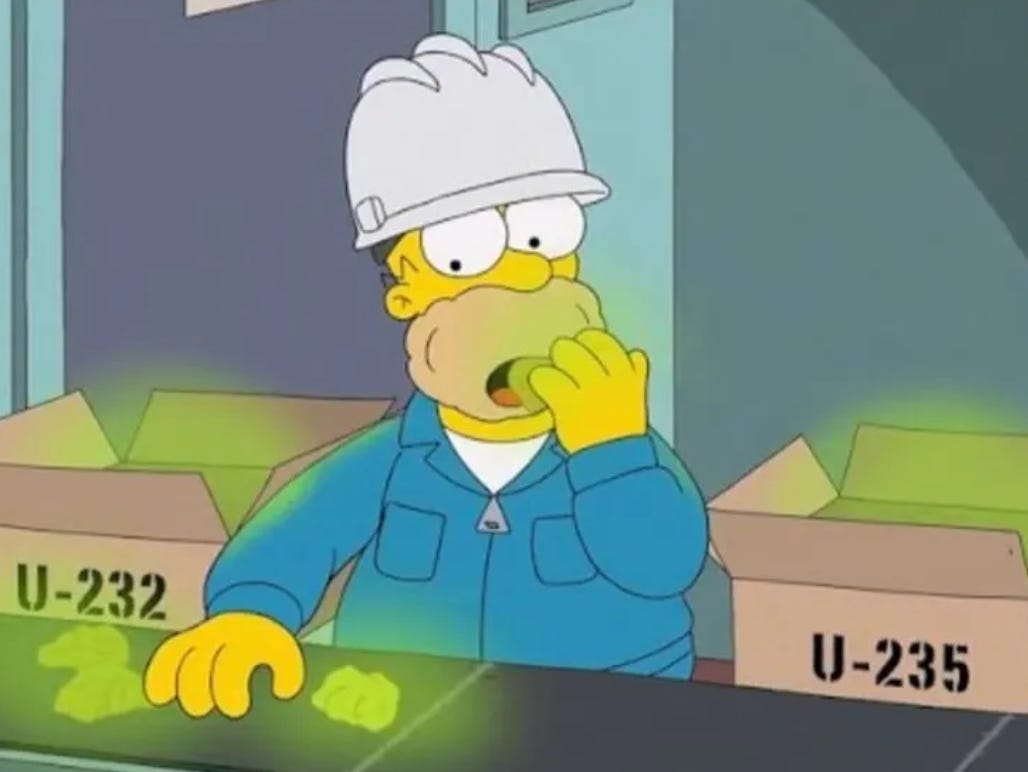
After The Simpsons, the GGU trope shows up a lot in media, notably in video games. In the Civilization series, starting with Civilization III (2001), uranium appears as a glowing ore that you can build mines for.

The trope is also found in Factorio, Satisfactory, Fallout, the fan game Pokémon Uranium, etc. Sometimes what glows green is ore, sometimes metal, sometimes nuclear waste. (Nuclear waste is more than 90% uranium.) Even YouTube videos that purport to teach us about reality can’t resist using the striking green color for their thumbnails.

But before the 1990s? I couldn’t find any examples of glowing green uranium, specifically. It’s hard to make a definitive claim based on absence of evidence, but I did a fair amount of searching, and it does seem plausible that The Simpsons was the origin of the incorrect trope. All similar, earlier examples are missing at least one element: e.g. glowing green substances are an older trope, but those are never uranium. At the very least, Matt Groening et al. are almost certainly responsible for crystallizing it in popular imagination.
So the obvious questions are: Where is the GGU trope from? And is it connected to the fluorescence of uranium glass somehow?
We start our investigation where every trope investigation starts: the popular website TVTropes. It contains several pages that are highly relevant to our interests:
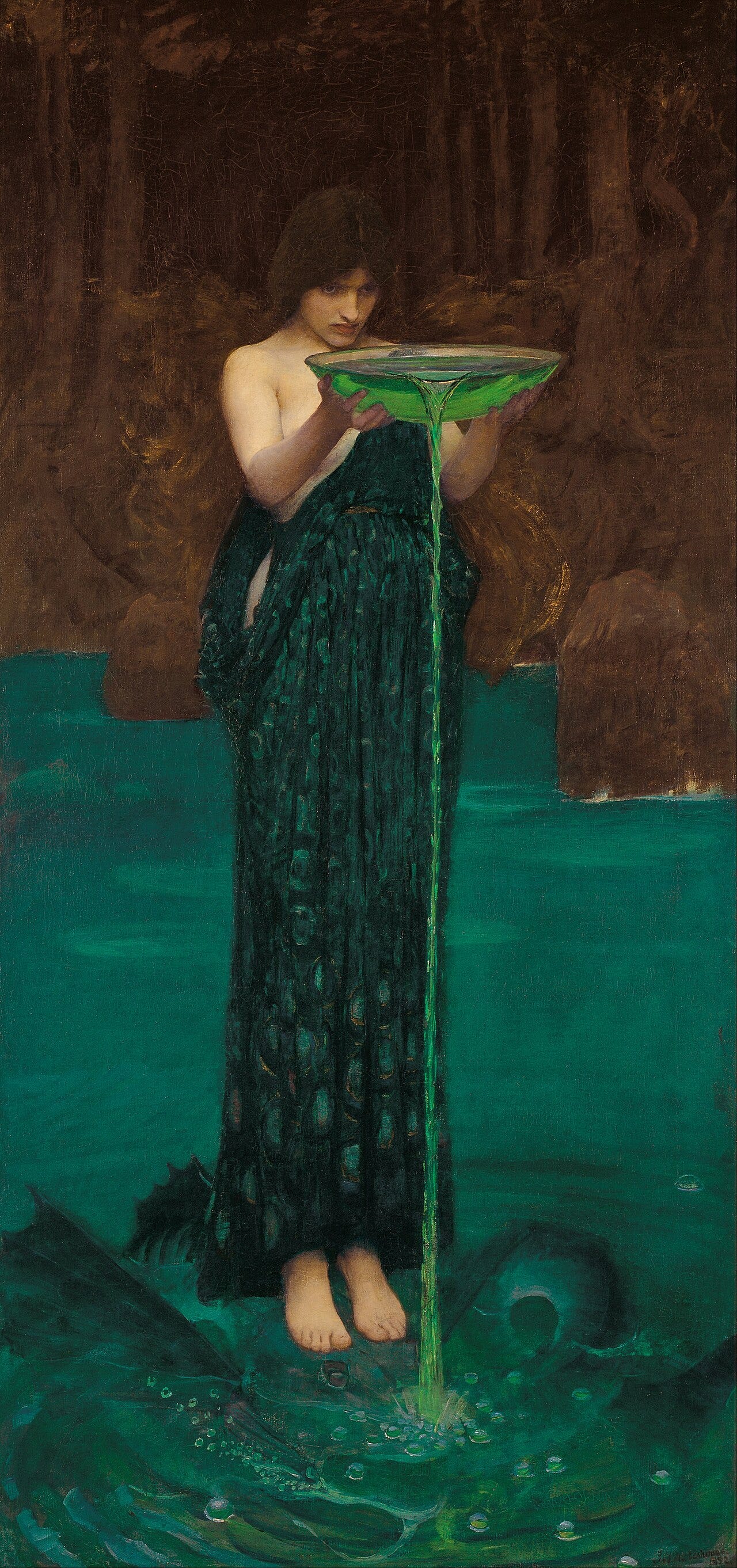
Technicolor Toxin describes the propensity of artists to depict poisons with bright colors, often green. This is an old trope, based on a paradoxical association of green with poison and sickness that dates from at least the 19th century, perhaps due to the highly toxic, arsenic-based pigments Scheele’s green and Paris green, or to the dangerous alcohol absinthe, or to the slight green tinge of human skin when we get nauseous. See for instance Circe invidiosa, the cover image for this post.
Green Rocks is the trope that consists of attributing special properties to minerals, and giving them the color green to make them special. The canonical example is kryptonite from the Superman franchise, which also happens to be radioactive and maaaaaybe connected to uranium in some way (the sources aren’t that clear on this point). But the trope is older than kryptonite’s 1949 appearance, e.g. in Depression-era pulp fiction stories. Also, kryptonite wasn’t even green at first.

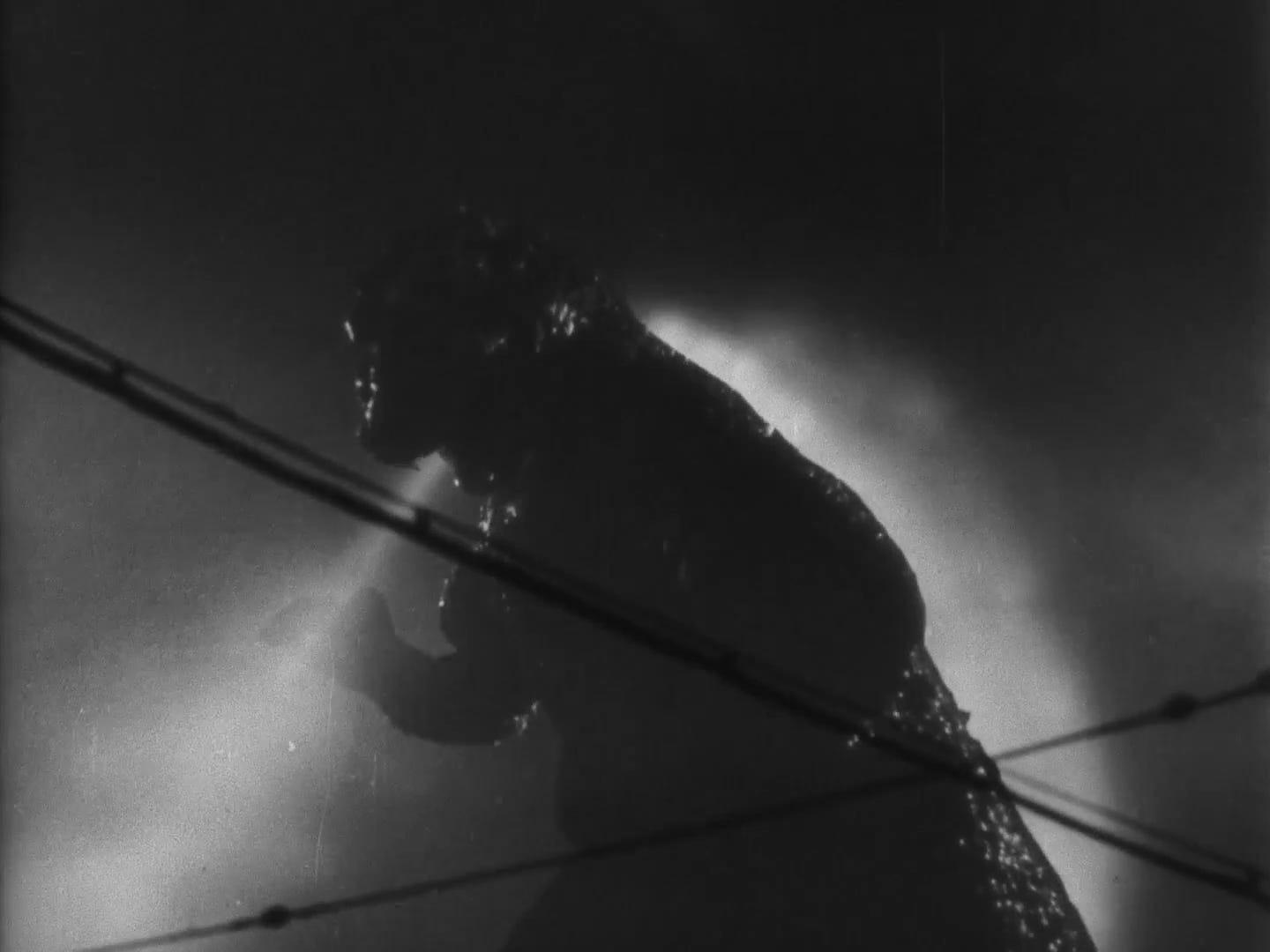
Nuclear Mutant is pretty self-explanatory: radiation can cause mutation, which creates monsters and/or superpowers. The “trope maker” here is The Beast from 20,000 Fathoms, a 1953 movie in which a prehistoric monster wakes up due to nuclear bomb testing in the Arctic. I’m not sure if this beast was a mutant, strictly speaking, but Godzilla — who was inspired by it, was invented in 1954 in Japan amid national nuclear trauma, and is far more famous — definitely was. The trope probably has origins in the 1920s, when it was discovered that x-rays can cause genetic mutations, combined with awareness of the toxic effects of radioactivity. After Godzilla, it also shows up abundantly in things like comics, such as The Incredible Hulk, who became like this due to gamma ray radiation, or Spider-Man, bitten by a “radioactive spider” (whatever that means). Later we also get the Teenage Mutant Ninja Turtles.
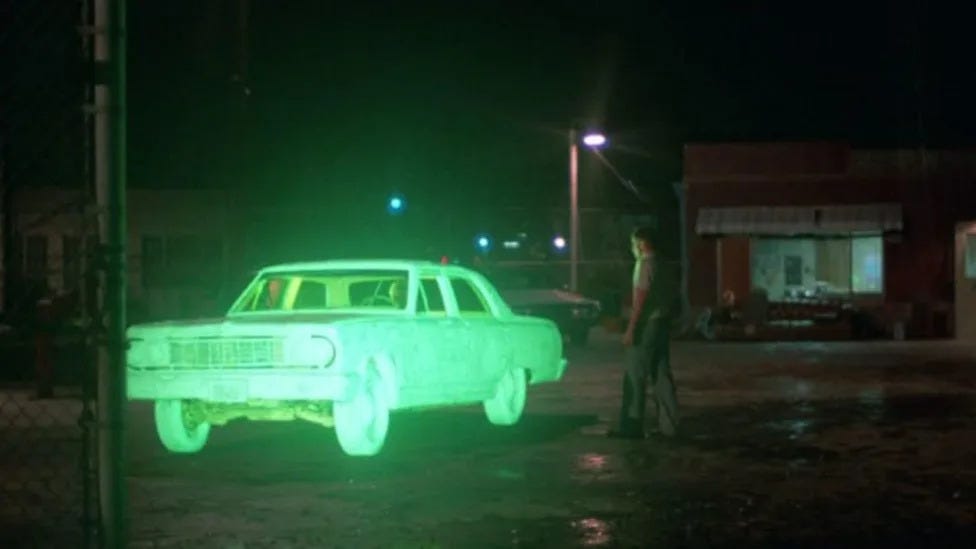
There are other relevant tropes on the Radioactive Tropes page, but Sickly Green Glow is clearly the closest one we have to GGU, only missing the specific uranium content. Green glows have commonly been used in media to represent bad or dangerous power, often but not always from nuclear sources. For example, consider the glowing green car in the 1984 film Repo Man, due to something mysterious and extremely dangerous (possibly the corpse of a radioactive alien) in its trunk. As we’ll discuss in detail later, this trope likely has its origins in the very early 20th century.
To these fun TVTropes finds, I might add another, the nuclear waste barrel. This one is younger than we might expect: it seems to have arisen circa 1979 and developed throughout the 1980s, combining environmental scandals of the late 1970s (Love Canal and the Valley of the Drums, two places where companies had been dumping barrels full of toxic waste) and the nuclear accidents of the period (Three Mile Island in 1979, and of course Chernobyl in 1986).
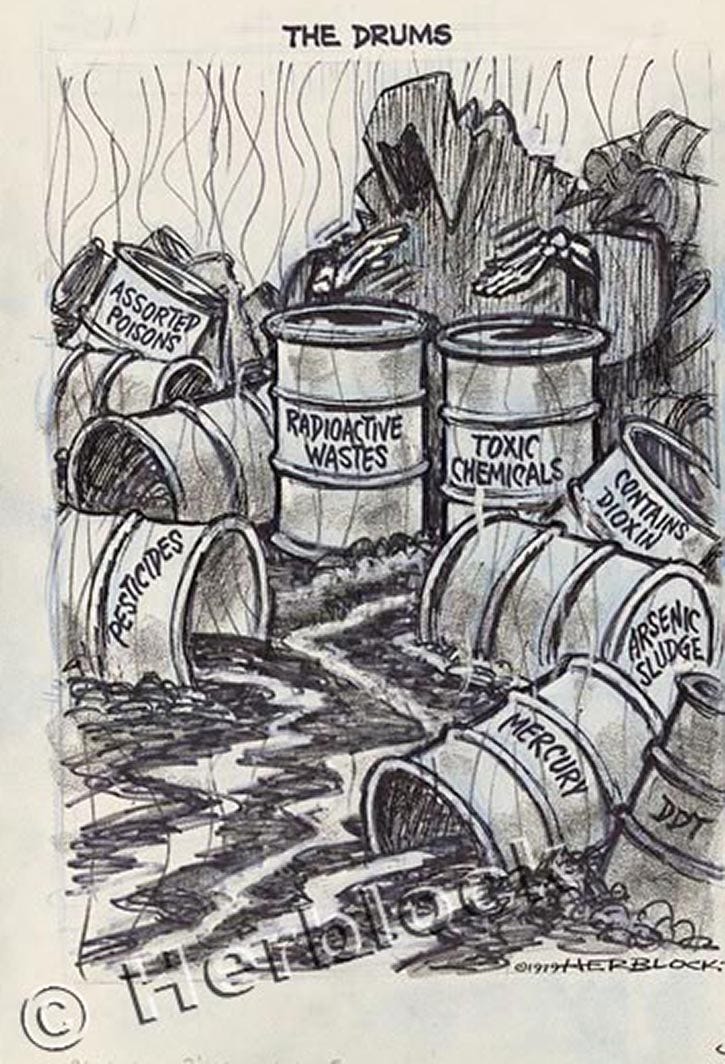
So when Matt Groening created the glowing uranium rod in The Simpsons, he had plenty of inspiration to draw from. Was uranium glass part of them?
I mean, I can’t really rule it out. Maybe he happened to own a black light as well as an old set of green-yellow glassware from the Great Depression. But attributing the GGU trope to uranium glass seems incorrect to me, for a few reasons.
First, uranium entered popular culture after WWII, in the aftermath of Hiroshima and Nagasaki, which coincides with the end of uranium glass production. I don’t know when, exactly, the glass was forgotten, but most people today have never heard of it, so it must have gradually lost its cultural presence starting in the late 1940s. Superman (which began in the 1930s) overlaps, but 1980s cultural artifacts like Repo Man or The Simpsons are quite far removed from the uranium glass era.
Second, uranium glass doesn’t look that special without the fluorescent effect under UV. But black lights, though they did exist starting in 1903 with Wood’s glass, didn’t become a widespread consumer item until the 1960s. Relatively few people would have been able to expose uranium glass to pure UV until then, except in specialized settings. It was at best a curiosity, which reduces probability that it had a big impact on popular culture. (To be clear, the fluorescence of uranium glass under UV was known to science for a long time — since the definition of fluorescence itself, in fact. George Stokes discussed uranium glass among many other substances in his important 1852 paper. So, yes, scientifically savvy people could be aware of this special property, and I can’t prove that this didn’t percolate into popular culture somehow.)
But should we count the UV in sunlight? Maybe the Victorians and Depression-era people saw their uranium glass glow bright green when they went on picnics, which would have had a tangible cultural presence! Fortunately, this is a test I could run myself:
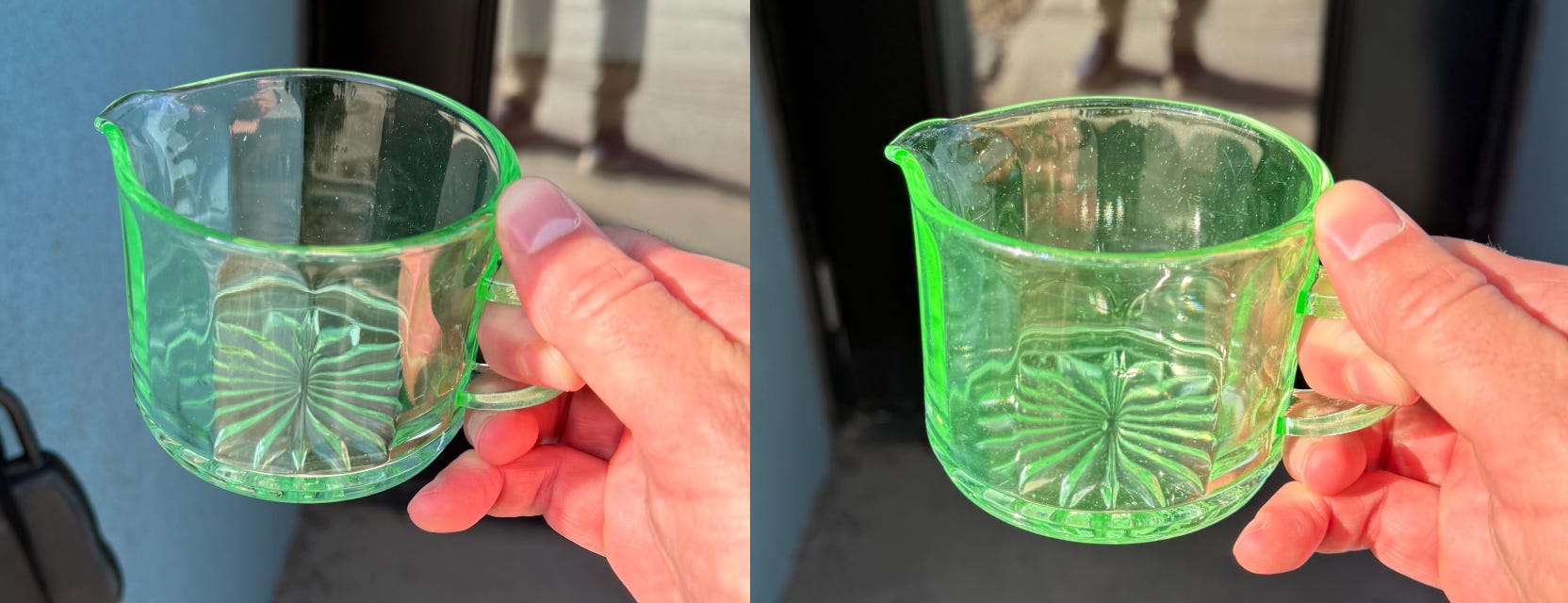
And… well, it’s not nothing, it does look brighter in the sun. But not nearly as eerily as when I expose it to a black light in an otherwise dark room. It’s also, you know, exposed to direct sunlight. My hand also looks pretty bright in that picture, and it doesn’t fluoresce (much). Based on this test, I think the special properties of the glass do show to some extent in sunlight, but not strongly enough for that to have had a particularly strong impact.
Third, when uranium did get its cultural moment, it wasn’t being depicted as green and glowing at all. This was the 1950s: the time of the “uranium boom” in the US, when the government handsomely rewarded prospectors who found domestic sources of the ore, and when popular culture went ahead and made uranium-themed games, toys, movies, TV shows, songs, and even buildings. Uranium was everywhere, but crucially, everywhere it was yellow. (Which makes sense considering that uranium compounds can be very yellow indeed.)
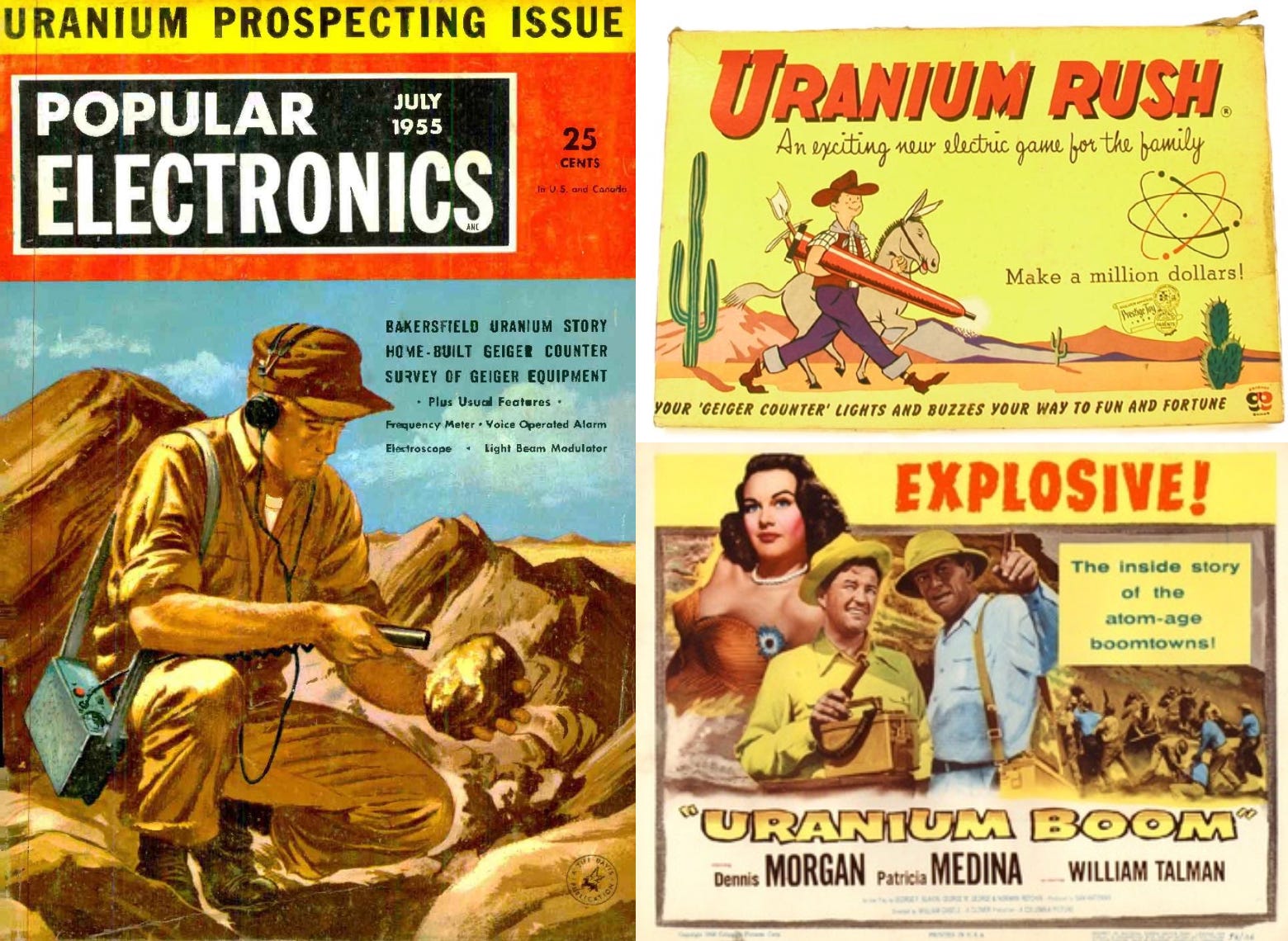
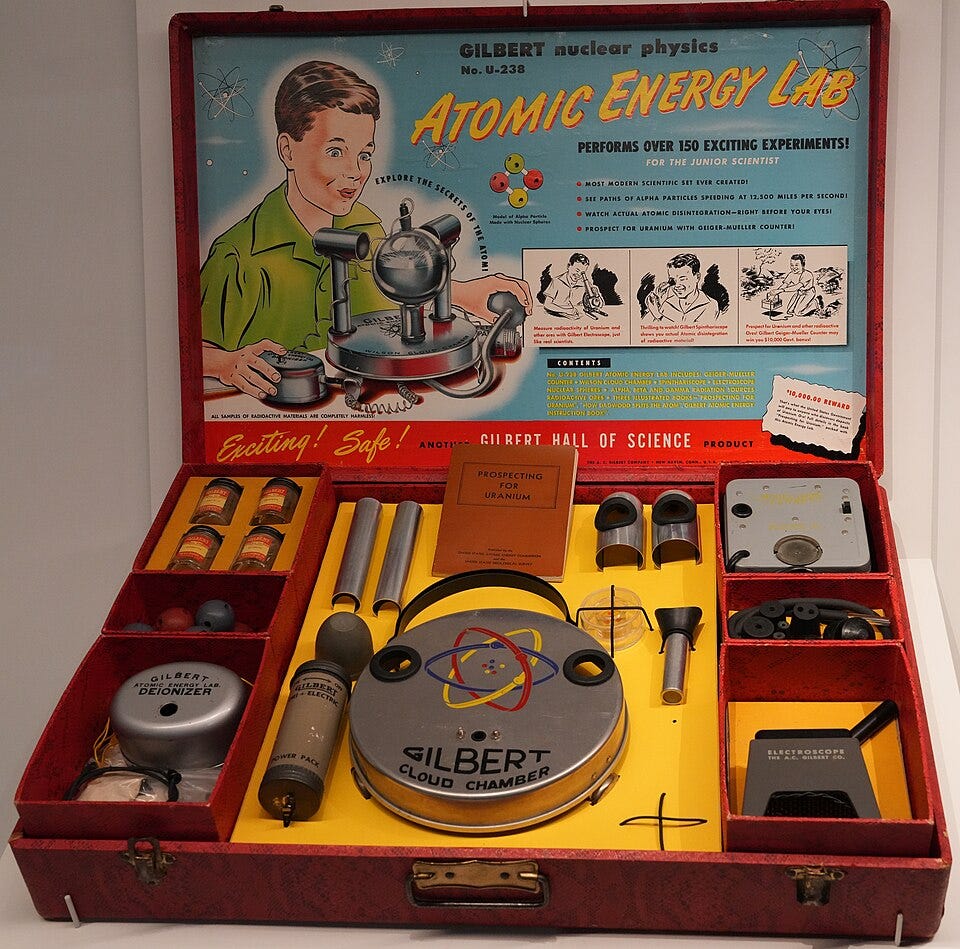
These things were created a mere two decades after the peak of uranium glass production. You’d think that they would have used its color if it had been culturally prominent, but nope, none of that green at all.
But the biggest blow to the uranium-glass-to-GGU-trope theory is that there is a much better competing theory, and it involves Marie Curie, literal tons of pitchblende, and many unfortunate people who died from totally preventable diseases.

Radium is a little bit like uranium’s flashier, younger sibling: a wunderkid who dazzled early, fizzled, was cancelled due to toxic behavior, and lived its later life in near total obscurity.
Radium owes both its existence and its discovery to uranium. Its existence, because it is created as part of a radioactive decay chain that begins with uranium; its discovery, because of the following story. In 1896, Henri Becquerel was trying to study the luminescence of various chemicals by placing them on photographic plates in the sun. When the Paris weather got cloudy, he put his plates in a dark cabinet and went to do something else. When he came back to the lab, he then noticed that the uranium salts — and only those — had cast a shadow onto the plate even in the dark. He correctly deduced that the uranium had emitted something; he had discovered radioactivity. Soon after that, Marie Curie and her husband Pierre investigated these mysterious “uranium rays,” and realized that pitchblende was more radioactive than the uranium content could account for. It turned out that the ore contained tiny amounts of elements far, far more radioactive than uranium: polonium and radium.
(In the metaphor, polonium is the bum with an unstable personality that never amounted to much — it has a short half-life, as well as high toxicity, so it’s hard to use it for anything.)
Radium is three million times more radioactive than uranium, and because of this, its compounds glow, faintly. Marie Curie wrote that she was mesmerized, sometimes entering the lab at night just to look at the bluish aura around radium chloride, caused by the ionization of air. This is where we get our first association of a glow with radioactivity. It is grounded in reality, but has nothing to do with uranium, fluorescence, or the color green.
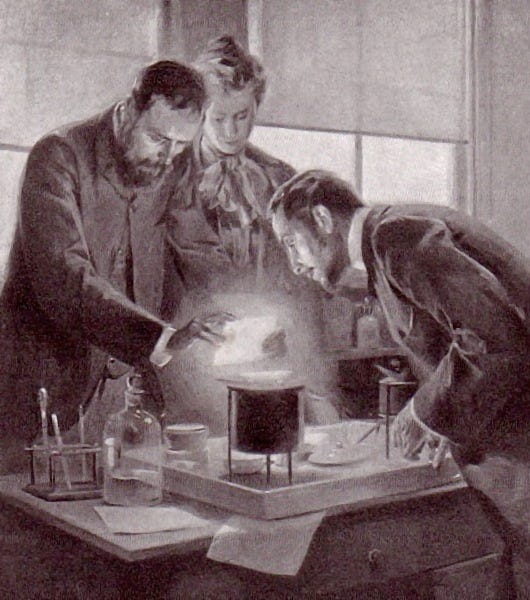
In 1902, an American engineer, William J. Hammer, visited Paris and received samples of radium from the Curies. He mixed the new element with a paint binder and copper-doped zinc sulfide, which was known as a phosphorescent chemical. The radium’s radiation activated the zinc sulfide and made it glow an eerie green light. Thus was born luminous paint.
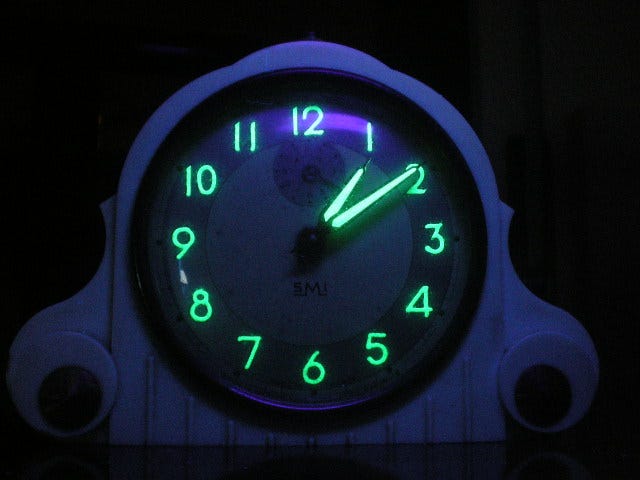


It’s worth noting that the green color comes from the zinc sulfide phosphor, not the radium; the radium just provides the energy that activates the phosphor. Zinc sulfide can also be activated by other things, including cathode rays in old TV screens (both the blue and green of old RGB screens come from zinc sulfide, in fact), so it’s not, strictly speaking, the color of radioactivity. Nevertheless, the damage was done. Luminous paint became an industry, radium became a prized resource — at its peak, 100,000 to 180,000 times the price of gold by weight! — and popular culture became as mesmerized as Marie Curie had been.
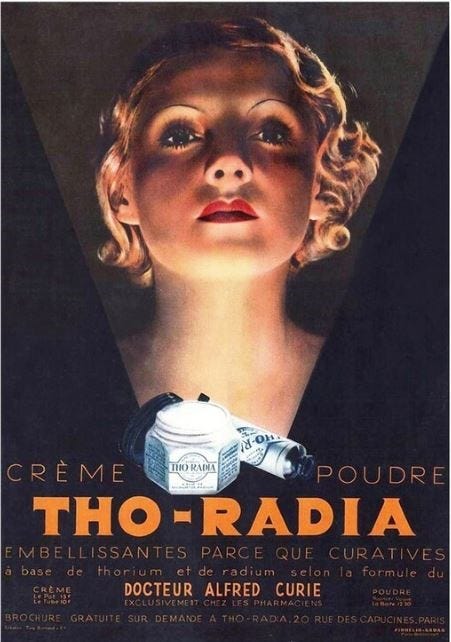
There were self-luminous dials and instruments, and companies to manufacture them. There were investigations into the potential of radium to treat cancer. There were beauty products made with radium for its supposed therapeutic virtues. There were beauty products that purported to contain radium but didn’t, since it was so expensive. There were radium bathhouses in Bohemia and the US and Japan. And then there were the Radium Girls, who worked in the luminous dial factories without protection and became sick from the radiation. There were lawsuits, and new labor protections. There was Sabin Arnold von Sochocky, founder of the United States Radium Corporation, who died from aplastic anemia due to radium exposure. There was Eben Byers, a rich socialite who died from jawbone cancer after consuming more than a thousand bottles of Radithor. There were expansions to the powers of the Food and Drug Administration so that it could ban radioactive medicines. There were people who lost a lot of money buying fake radium products but who at least, as a mercy, did not develop aplastic anemia or jawbone cancer.


There was also the processing of enormous quantities of pitchblende and other uranium ores, just to get the tiny amounts of radium they contained. A ton of pitchblende contained only about 0.1-0.3 gram of radium. New mines beyond Czechia were found in Colorado, Utah, the Belgian Congo, and the Northwest Territories of Canada, and this industry created a lot of nearly useless uranium as a byproduct. Hence, cheap uranium glass.
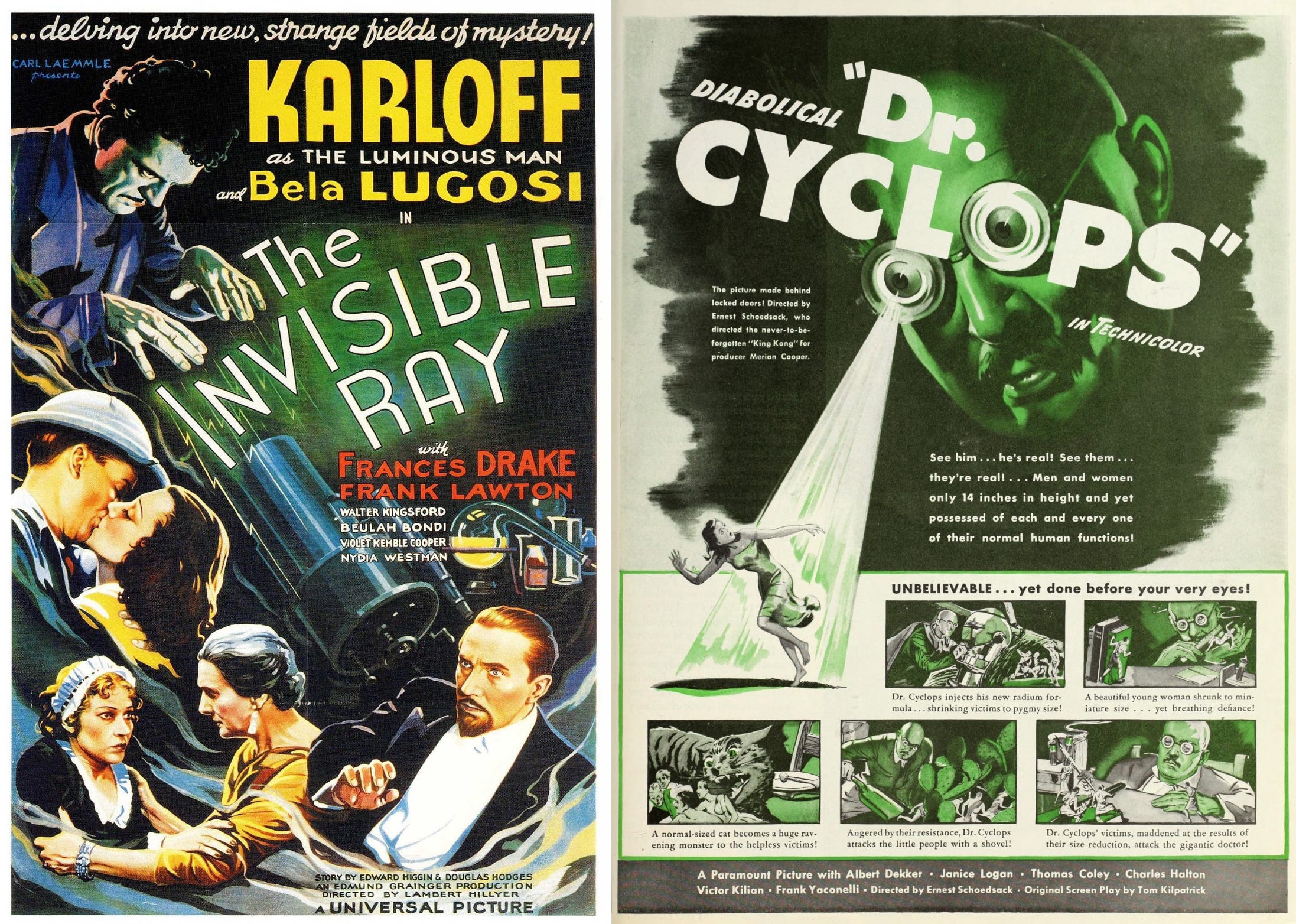
But uranium glass wasn’t necessary for the birth of the green glow trope: all the elements, except uranium, were already there. The glow (from Marie Curie), the green (from William Hammer), the toxicity (from the Radium Girls and Eben Byers). Eventually, popular culture picked it up. The 1936 movie The Invisible Ray has the unmistakable glow on its poster to emphasize the danger of its “Radium X” beam.
Dials painted with radium continued to be produced into the 1960s (with better protection for the factory workers). Radium therefore overlaps with the early Atomic Age much better than uranium glass, and besides it was far more well-known to begin with. So it seems to me that it is much more likely to have provided the cultural background for green glowing tropes when they did eventually arise, including kryptonite, nuclear waste barrels, and Homer Simpson’s uranium rod. It probably coexisted with yellow uranium and nuclear mutants of no particular color for a while, and then — perhaps when radium did finally vanish from industrial production and popular culture — its green glow was recycled into nuclear imagery, since it was available.
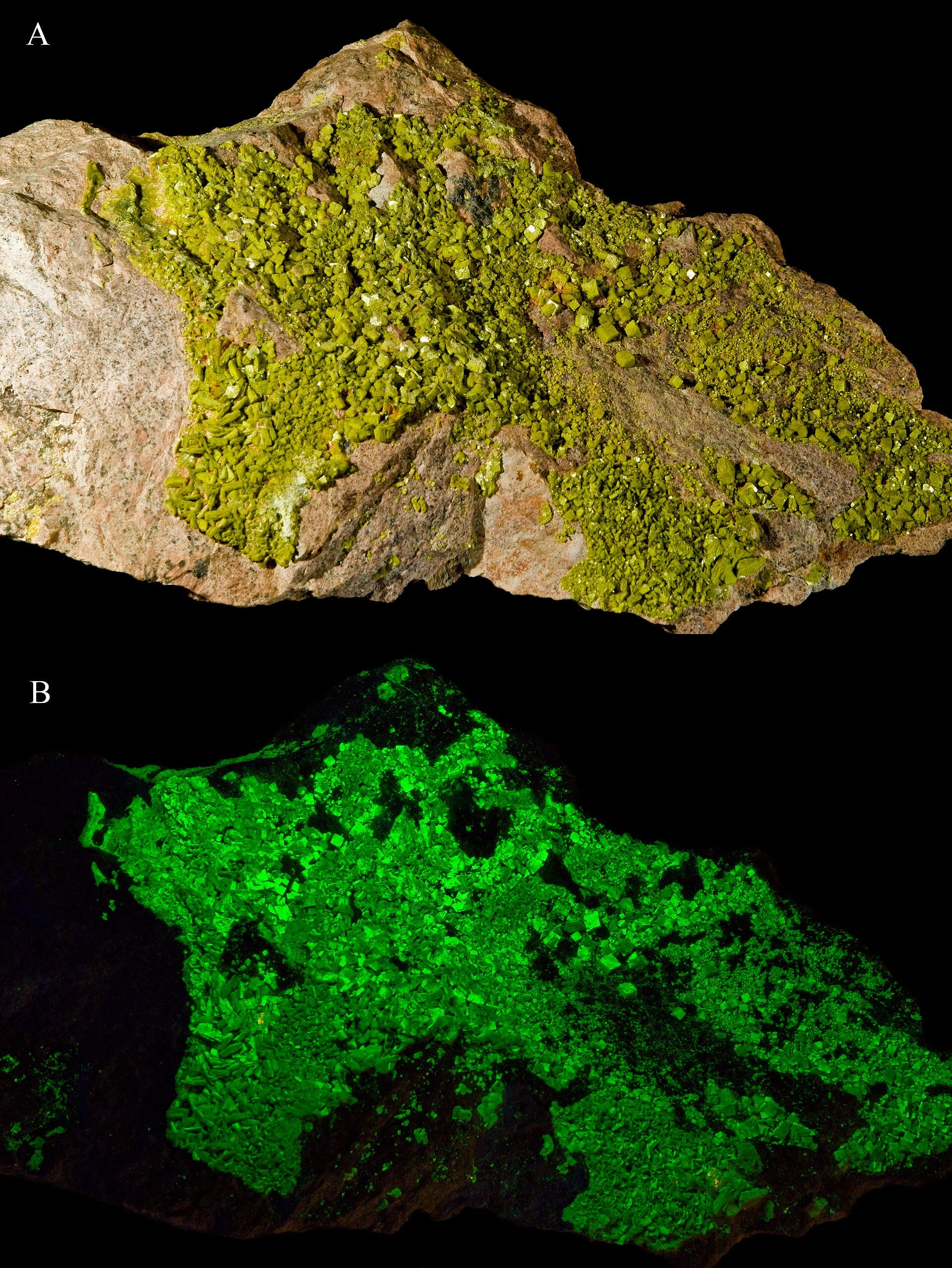
Now, of course, there are ways for the creators of The Simpsons or Civilization to justify their use of the GGU trope. If they did some research, they might have found out about the fluorescent green of uranium glass and decided this was close enough. Or they might have discovered other possible inspirations I didn’t discuss, like the blue Cherenkov radiation of nuclear reactors, or the sickly yellow-green of compounds like uranyl nitrate, or the green fluorescence of certain uranium ores rarer than pitchblende.

_France.jpg)
But let’s be real: any of those would almost certainly be a retroactive fitting of the trope. The real reason uranium glows green in their creations is that they wanted to make uranium distinctive and they drew on a popular imagery that had been developing since the Age of Radium. At best, maaaaaybe the bright hue of the green comes from the fluorescent effect, since that’s distinct from the green of zinc sulfide. But that could also just come from the generic toxic green trope.
So, no, I don’t think the color of uranium glass is related to the color of popular culture uranium and radioactivity. I think it’s a big joke, played on us by chemistry and physics. It has fooled TVTropes; multiple AskScience and AskHistorians Reddit pages; several instances of Claude, Gemini, and Elicit that I chatted with as research for this post; and myself, until now.
My uranium glass cream and sugar set sits next to me on my shelf, emitting mild radiation and beautiful green photons, without any connection whatsoever between these two things. It’s the coolest thing ever, and if I were designing a fictional universe I would definitely not come up with a coincidence this stupid.
Thanks to Mike Riggs and Elizabeth Van Nostrand for feedback on this piece.
Si je tape dans Google « what material is the rod in homer simpson real », tu es le 5e lien qui apparaît! 💚