


I’m not sure I have ever gone into a movie having consumed so much media about it. I read the book; that was perhaps 10 years ago, after having purchased the (dated, academic) Victor Bérard translation in a used book shop in southern France. I enjoyed it, and am glad I read it, but it did not make that big of an impression on me. It was cool but also kinda weird.
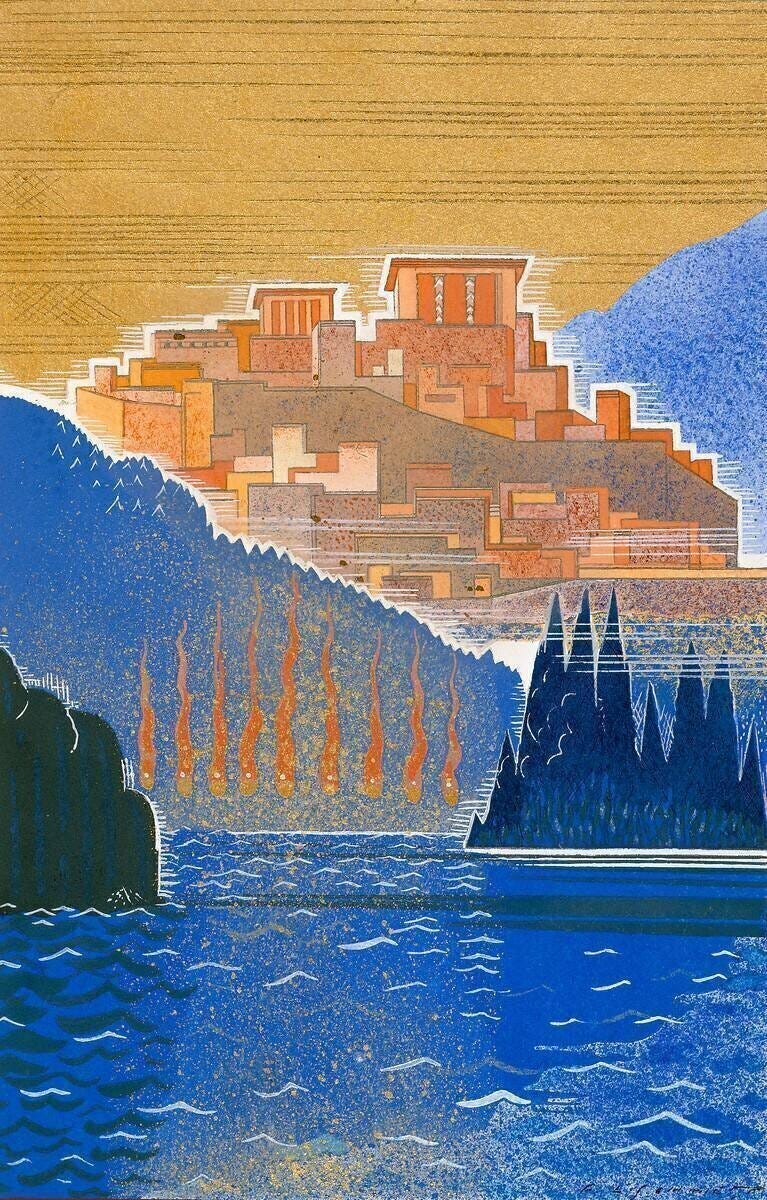
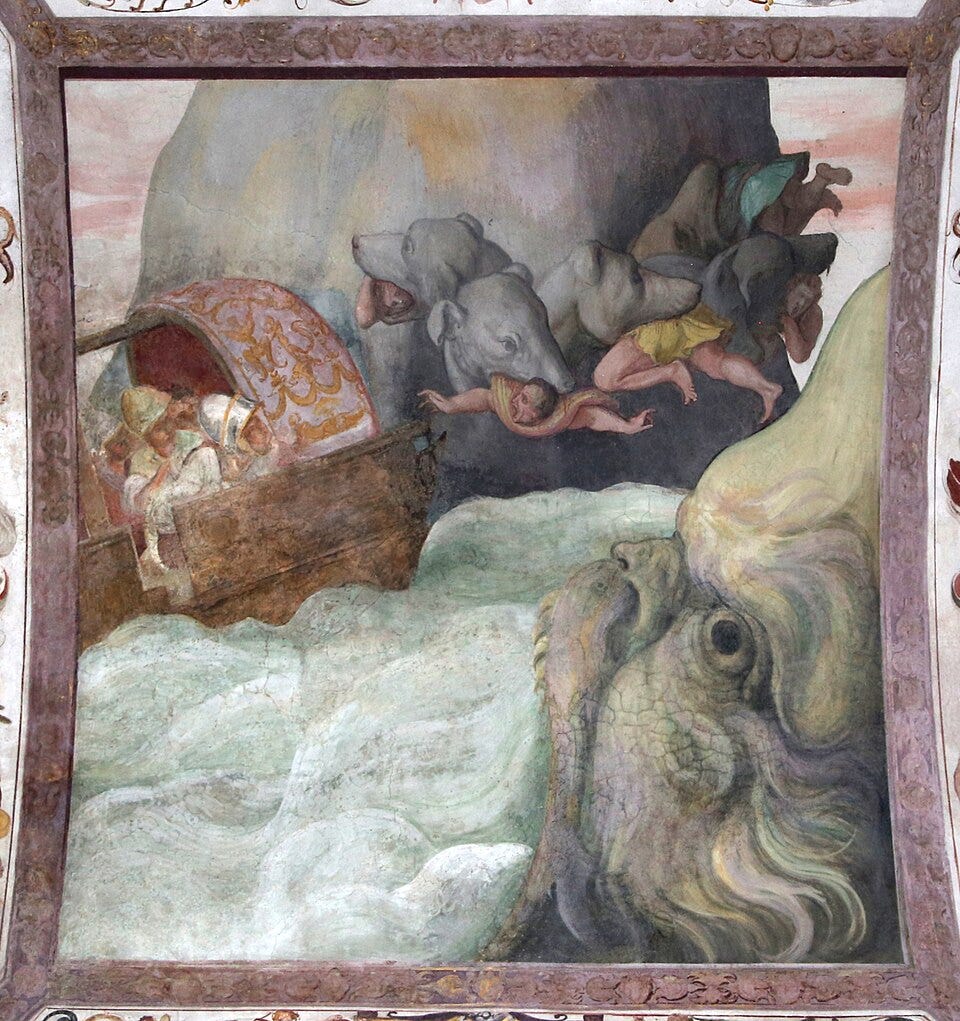
I had previously read Ulysses by James Joyce without much knowledge of the Odyssey. (I do not recommend this. Nor do I recommend reading it with knowledge of the Odyssey, either, but what do I know.) I also had various phases of geeking out about Greek mythology, as one does. Eventually I began using Odyssey materials in my own writing. I wrote a 100-tweet Twitter thread about beauty in which each tweet was adorned by the Art Deco illustrations to the Odyssey by François-Louis Schmied. I wrote a blog post using the Charybdis and Scylla metaphor, which led me to an art rabbit hole from which I emerged deeply dissatisfied with the existing artistic renditions of these two monsters. More recently I played Hades II, which is perhaps, surprisingly, the best modern reinterpretation of the Odyssey I’ve come across, even though it’s not primarily about the Odyssey. It does feature, as secondary characters, Odysseus, Charybdis, Scylla, the sirens, Polyphemus, and Circe, as well as the usual cast of Olympian gods, and they’re all a lot of fun.
Christopher Nolan’s new movie The Odyssey is apparently not very fun. It’s also very fun. It’s very woke, and also the most conservative movie in years. It contains the pathologies of contemporary filmmaking like colorless grey filters, and also it is an old-fashioned movie, shot with minimal computerized special effects on 70mm film, but it’s also the first movie to ever be fully shot in IMAX. It is alien and reflective of Bronze Age culture (xenia, renamed as Zeus’s law) and also somehow steeped in modern Christian-inspired ethics (the Golden Rule) and involving modern themes like PTSD and angst about civilizational collapse. It is historically inaccurate, completely getting wrong the aesthetics of the Homeric setting, which is not a setting you can be accurate about since it was never part of history. It is based on the controversial translation by Emily Wilson, but Emily Wilson didn’t love it and also it turns out that it is not actually based on the controversial translation by Emily Wilson.
I don’t know, I haven’t seen it yet. I’ve just seen the discourse. Lots and lots and lots of discourse, filling more than half my Twitter timeline in the past several weeks, and in smaller doses for the past year or so as information about the movie trickled in. I have not resisted absorbing it all. I’ve read dozens of reviews, listened to the soundtrack (PSA: it is NOT great music for the gym), read the synopsis to refresh my memory (no reason to care about spoilers for one of the best-known works of literature of all time).
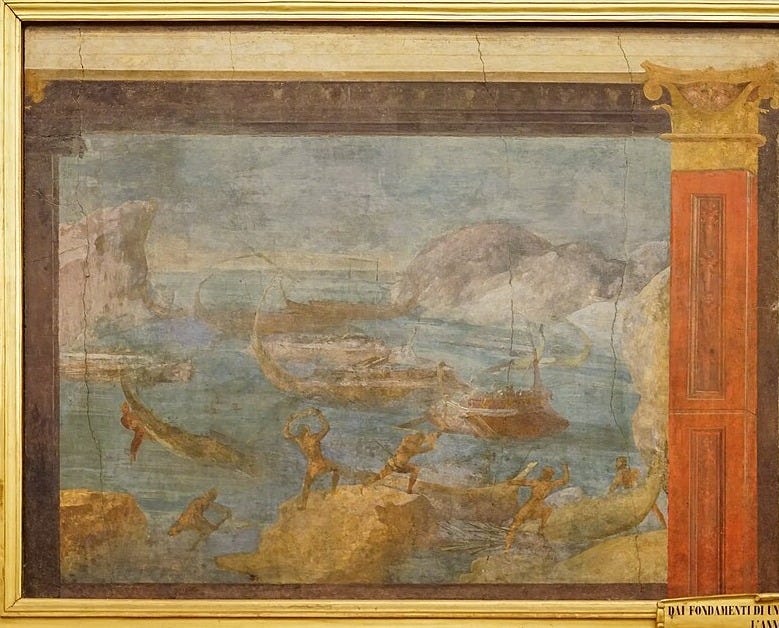
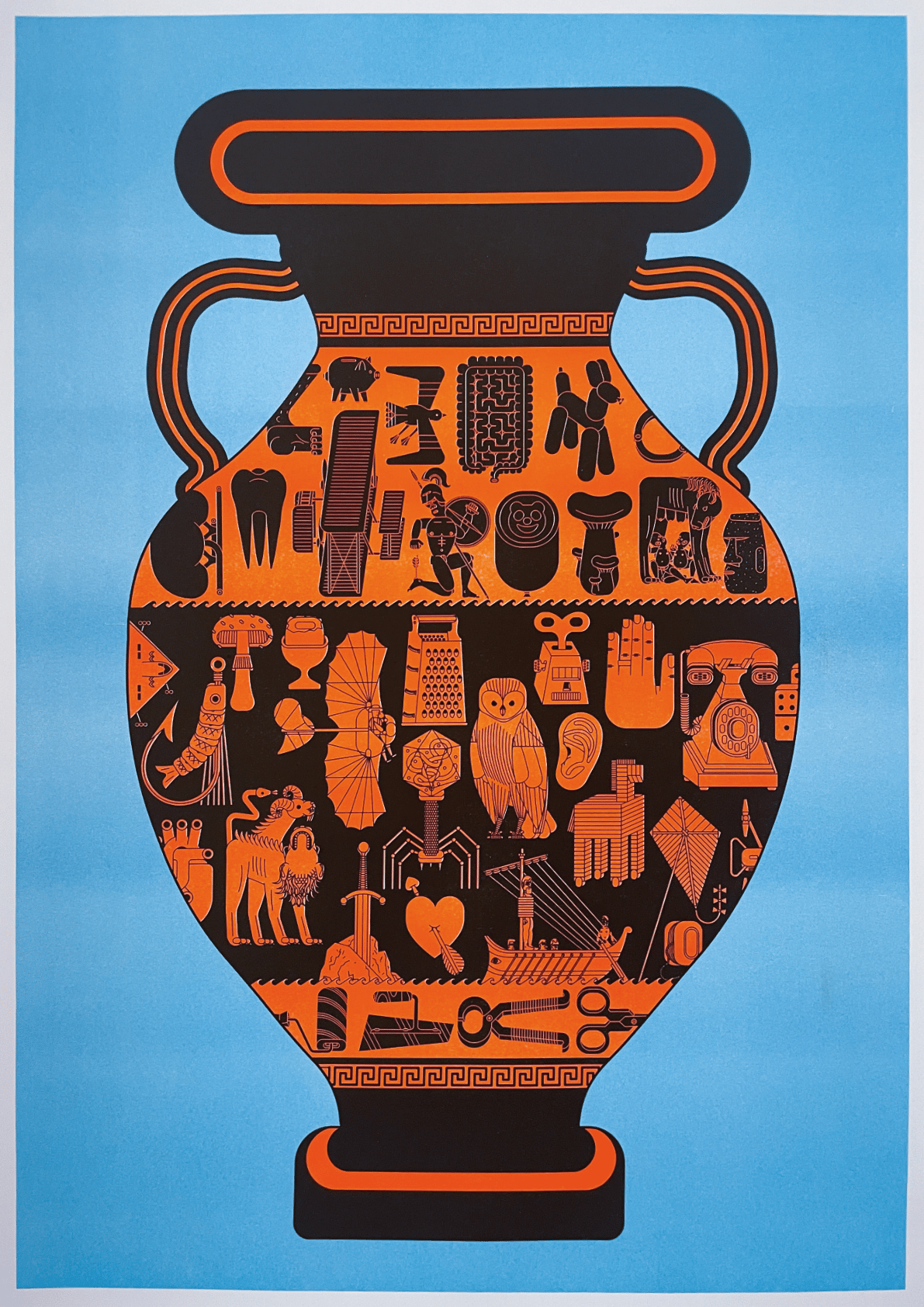
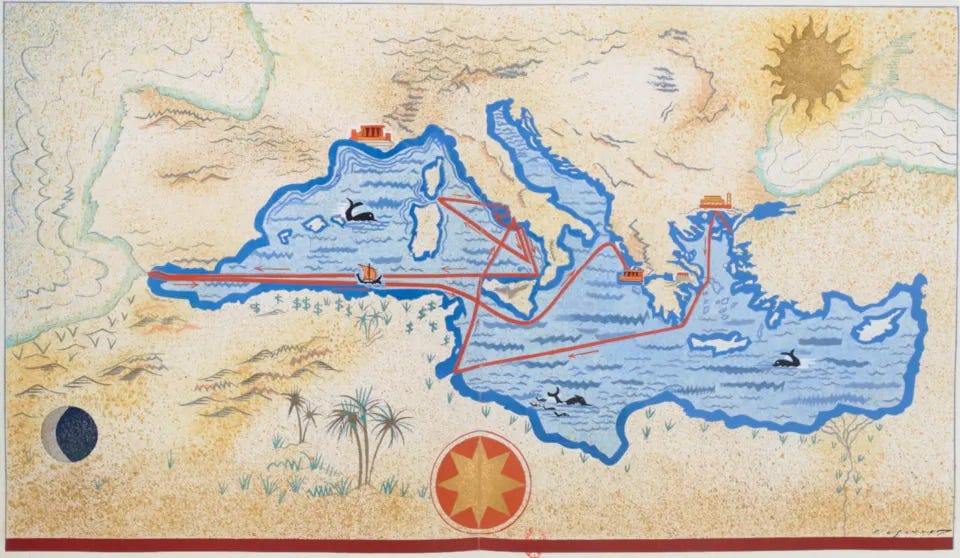
I ended up with an epic Mediterranean kind of mood. I have been decorating my apartment with artwork like these:

And more importantly I just booked a trip to Sicily, Malta, and Tunisia, basically the setting of the travelogue part of the Odyssey, a few weeks from now. I hope I make it back in the expected 10 days rather than 10 years.

The Odyssey involves a number of monsters, almost the progenitor of the “monster-of-the-week” trope. So it occurred to me that I ought to somehow participate in the discourse. The obvious move would have been to write my review of the movie, but I couldn’t do that. Overdone, passé. So I thought I could be clever with a “pre-watch review,” but the all-encompassing nature of the discourse means that this has already been done, too. Well, whatever. The real reason I’m doing this is that I made a promise to myself I would publish at least one post per calendar month, and I haven’t done anything for July yet, and I’m going to see the movie on July 31st because getting IMAX 70mm tickets is a multi-week project, and if I wait until then to write my review we’ll be in August.
Besides, I probably won’t have anything particularly smart to say about the movie itself. Like previous Nolan films, I’ll probably enjoy it, not love it, give it a solid 3.5 stars on Letterboxd. So, I thought, I might as well write about the true work of art here, which is vastly more epic in proportion than anything Homer or Nolan could ever come up with: the hilariously entertaining cultural reaction to it.

The overall narrative arc is great. Some extremely online people — mostly this annoying demographic that is variously described as right-wing or anti-woke but is something far worse than either of these two things — deciding a long time ago to wage a culture war against The Odyssey, primarily because of the casting of non-white actors to play Greeks and of a trans man to play Achilles (he does not play Achilles, and Achilles does not appear in the film). They latched on a lot of other perceived flaws as well, such as the use of a Viking longship rather than a real Greek trireme, or leaving out the “nobody” joke in the cyclops scene, which they maintain destroy the meaning of the entire epic. Eventually, “not seeing The Odyssey” became a matter of saving Western civilization. The online right decided to boycott the film, predicting it would be terrible. When the critics loved it, they predicted audiences wouldn’t. When audiences loved it and it had a great box-office start, they began believing in conspiracy theories about Rotten Tomatoes scores.

Lots of specific episodes were really fun too. There was Elon Musk promising that Grok would create a full-length “historically accurate” Odyssey movie by the end of the year (???). There was this well-known conservative commentator complaining about the nonlinearity of the film, thereby proving that he had no idea what was in Homer’s poem. (In fact I can’t really believe that most of these people pontificating about the Odyssey have actually read it, not that reading the book should be an obstacle to talking about it.)
I don’t want to give too much of a hard time to those wannabe defenders of Western civilization, though. They’re part of this gigantic work of performance art like everyone else. And they’re right about some things. I suspect that I, too, will find the film too serious, too desaturated. At some point we really should resume making historical or mythological movies with lots of life, humor, color, and exuberance.

Sometimes people talk of the “post-literate society,” or the “atomization of culture.” Instead of reading books and discussing our favorite art at salons, we’re supposedly all watching Netflix alone at home and being depressed. Now, admittedly, the two social networks I still use — Twitter and Substack — are text-based and are where people who love talking about books and culture hang out, so my view may be somewhat biased. But isn’t it rejoicing how many of us are treating a new version of one of the greatest works of literature as a major event? Isn’t it cool how we’re debating translations of polytropos and the bicameral mind theory and what really counts as an adaptation? How we’re all united in this great online party, whether as critics or fans?
I sense that the tide of the discourse is starting to recede now, a week and a half after the release. Time to send out this quick essay, and spend the next few days in anticipation of my watching. I look forward to it, because I like the Odyssey — way more now than when I read the Bérard translation — and also because it will imbue the previous several months with meaning. But really, I already got many, many hours of fun out of this film. Whether I end up liking it or not, I can no longer be disappointed.

J’étais en route pour aller voir le film.
Penelope, Léo et Kloé sont venus en métro.
Ils ont rejoint au banc de Berri pour les mener au cinéma par la suite: les 2 habitants
du vaste Plateau Mont-Royal, les 4 du Nouveau-Rosemont, celui de Verdun riveraine de la plage ainsi que celui de la lointaine Laval.
Ceux du centre sud, basse du pont, sont venus avec leur BIXI, sur lequel était monté 2 cyclistes téméraires.
La Honda Odyssey des boisés sacrés de Lanaudière, initialement conduite par Eleonor, puis par la suite par Thomas, arriva au cinéma avec leurs 6 vaillants spectateurs.
Etc.
I'd love to see your letterboxd, if you're comfortable making it public. Unless you meant that line rhetorically!
Great read! (The best review I read of The Odyssey, but it's not a review of The Odyssey.) Wonderful artwork. I've been encouraging people to just watch the film without the baggage, but perhaps that misses the point. I didn't care for the film, but I enjoyed the surrounding experience. Hope you actually like the movie, though.