


The Fushimi Inari shrine in Kyoto is one of Japan’s most popular tourist attractions. It is a large Shinto shrine, devoted to the deity (or kami) Inari, and covering the better part of a small mountain to the southeast of the city center. Past the large buildings at the base, visitors can walk the multiple trails of the forested hill, many of which are decorated with hundreds or thousands of bright vermillion sacred torii gates inscribed with black Japanese characters.
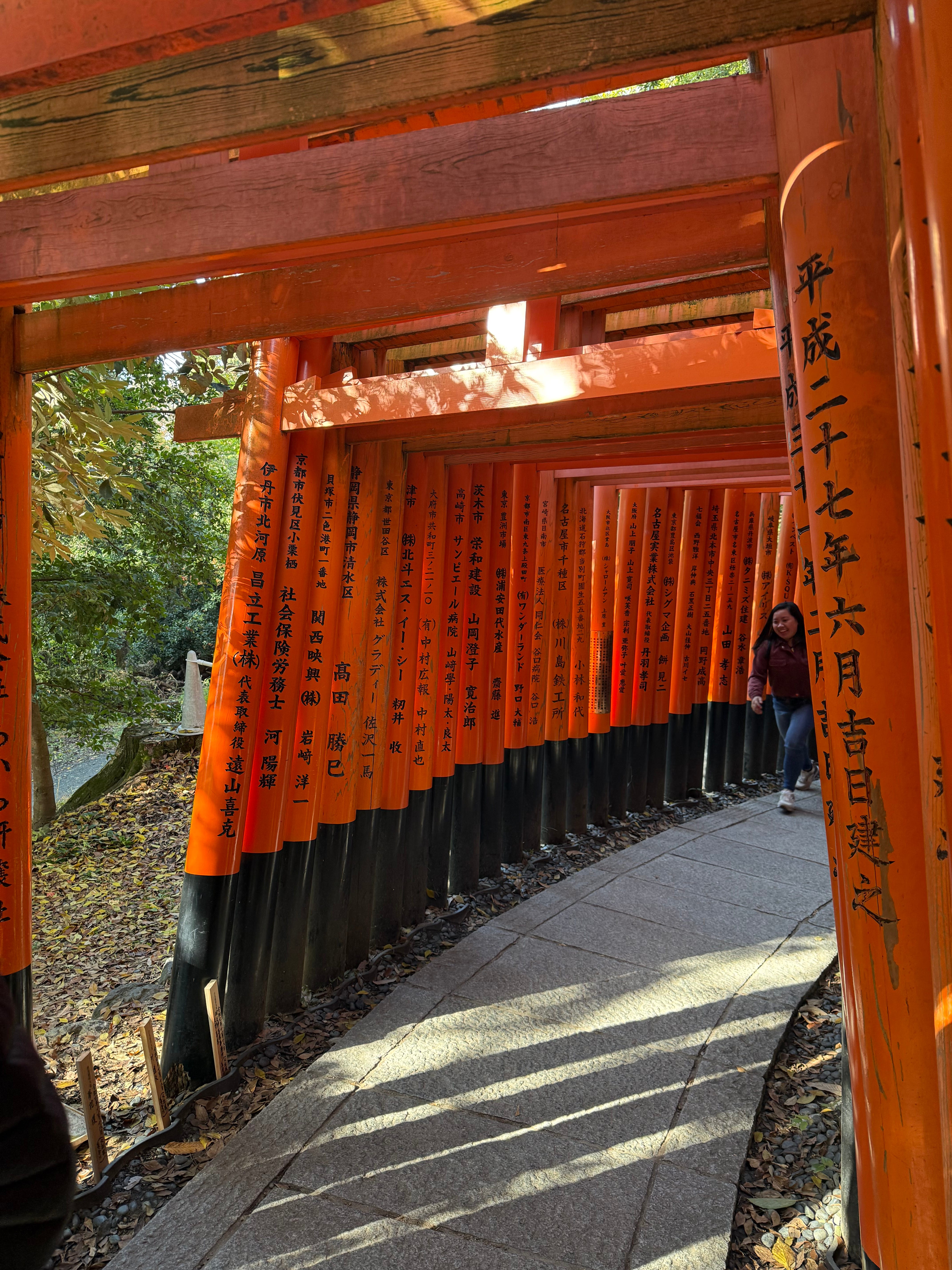

A foreigner with superficial knowledge of Japanese culture may wonder what compelled people to amass so many torii gates in one place. They might also ask about the meaning of all that Japanese text. This, some Japanese people have said, would be a mistake. The answer might unwittingly damage the beauty and wonder of the place.
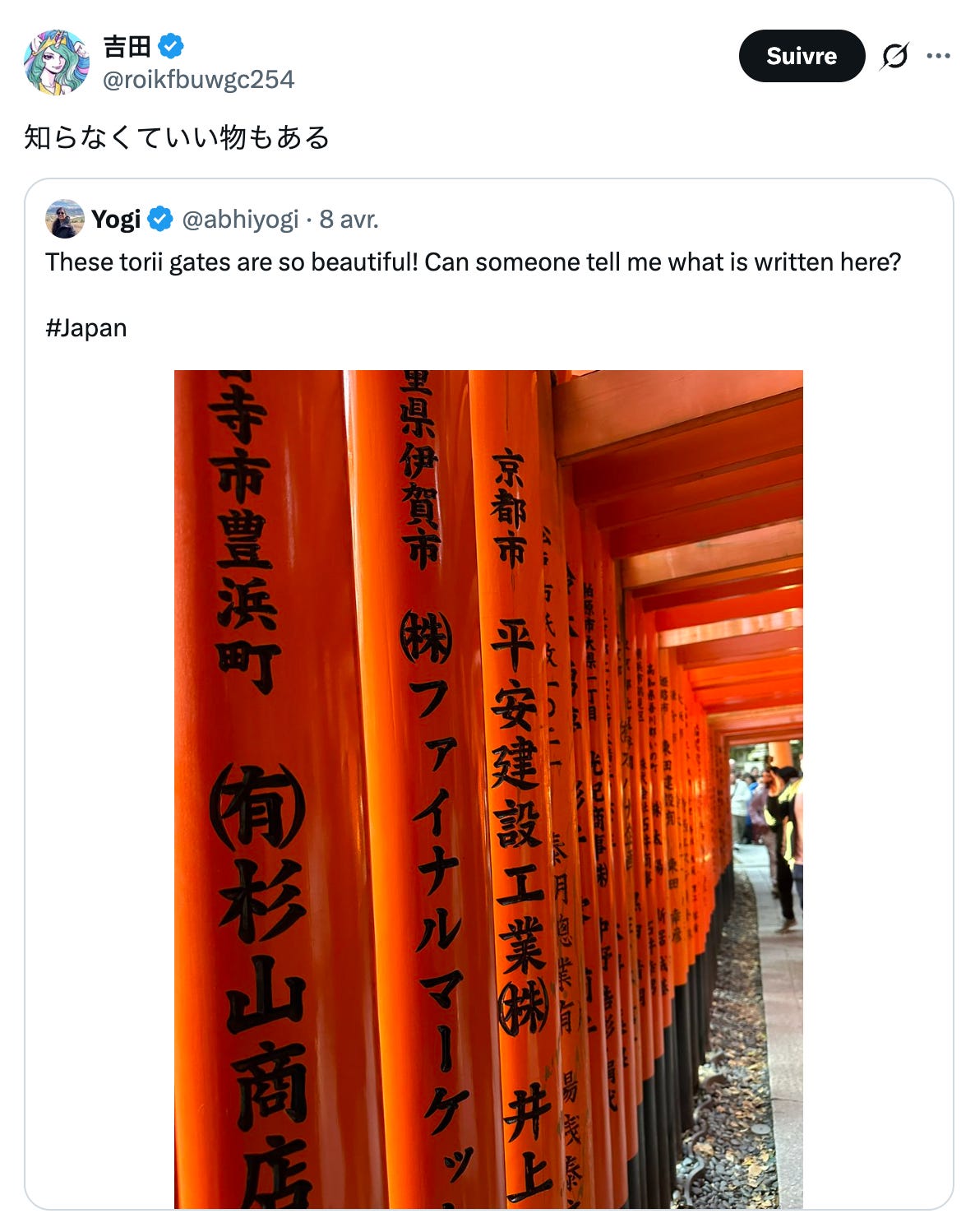
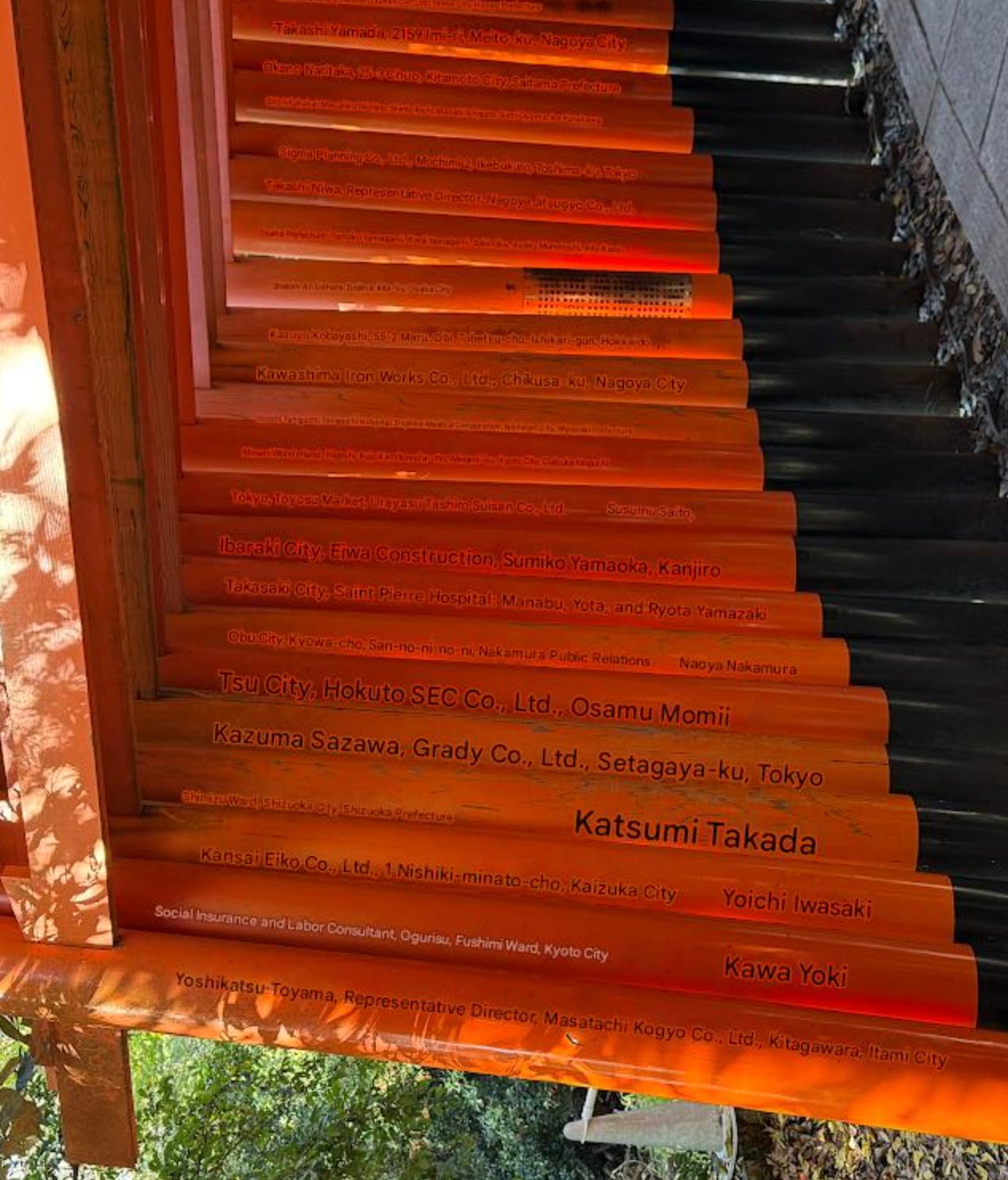
The forbidden answer is that most of these are the names of commercial enterprises. Inari is the kami of various things, including industry and worldly prosperity. It is therefore common for successful Japanese businesspeople to purchase and donate a torii to the Fushimi Inari shrine as a way to thank the deity for their wealth. They inscribe on it their name, or the name of their company. The result is that all of those black Japanese characters aren’t sacred or mystical messages, but rather, a long list of corporate sponsors.
Twitter was recently rife with posts about this,1 the vast majority of which agreed that such knowledge damaged the beauty and wonder of the place. It is apparently abundantly clear to Japanese and Westerners alike that corporate sponsorship on sacred objects makes the sacred object less magical, less beautiful.
This is, I believe, an instance of an extremely common pattern. Across the world, we tend to view the presence of commercial elements as somewhat ugly. We bemoan the presence of ads on websites, on TV, on billboards in a landscape. We describe movies or music we don’t like as “commercial.” We dislike the idea of a Burger King in a tourist site. We view capitalism as draining away the beauty and wonder of the natural world, by damaging the environment and encouraging greed.
One anecdote in particular struck me, at the very end of 2024. With some artsy cartoonist friends, we were watching the end-of-year TV shows on December 31st. In Quebec, these TV shows are kind of our equivalent to the Super Bowl in the US: they’re the most watched shows of the year, so the ad time during the breaks is valuable, and companies put a lot of effort into their ads — sometimes reaching such quality that it’s not easy to tell them apart from the comedy sketches of the shows proper. On 31 December 2024, during a commercial break, something like this happened: between two more mundane ads, we saw a performance of a song by the recently deceased Jean-Pierre Ferland, a major Quebec singer-songwriter, by 10 well-known local musicians. It was beautiful and clearly high production value, and the loud crowd in my apartment gradually quieted down, as if put under a spell, as the performance went on. It lasted a couple minutes, longer than a typical ad. And then, at the very end, the Coca-Cola logo came on screen for a few seconds.
And immediately there was, in the apartment, a collective boo of deep disappointment.
I didn’t say anything but I was bemused. You could feel my friends’ aesthetic appreciation go from genuine admiration to disgust. How dare Coca-Cola spoil this work of art with their commercial presence!
But why? Why would the presence of a commercial sponsor — who, it must be said, actually went through the trouble of commissioning this extremely nice homage performance, which otherwise would not have existed! — destroy its magic?2

One class of explanation might focus on history, trying to understand what brought us there.
Since we were talking about Japan, let’s start by pointing out that during the feudal era of that country, merchants were explicitly placed at the bottom of the class hierarchy. The four-class system, called shinōkōshō, was created by the Tokugawa government, placing samurai first, peasants second, artisans third, and merchants last. It came from Confucianism, and unsurprisingly, classical China had a similar structure and disdain for merchants (who nevertheless often grew to be very rich and powerful in both civilizations).
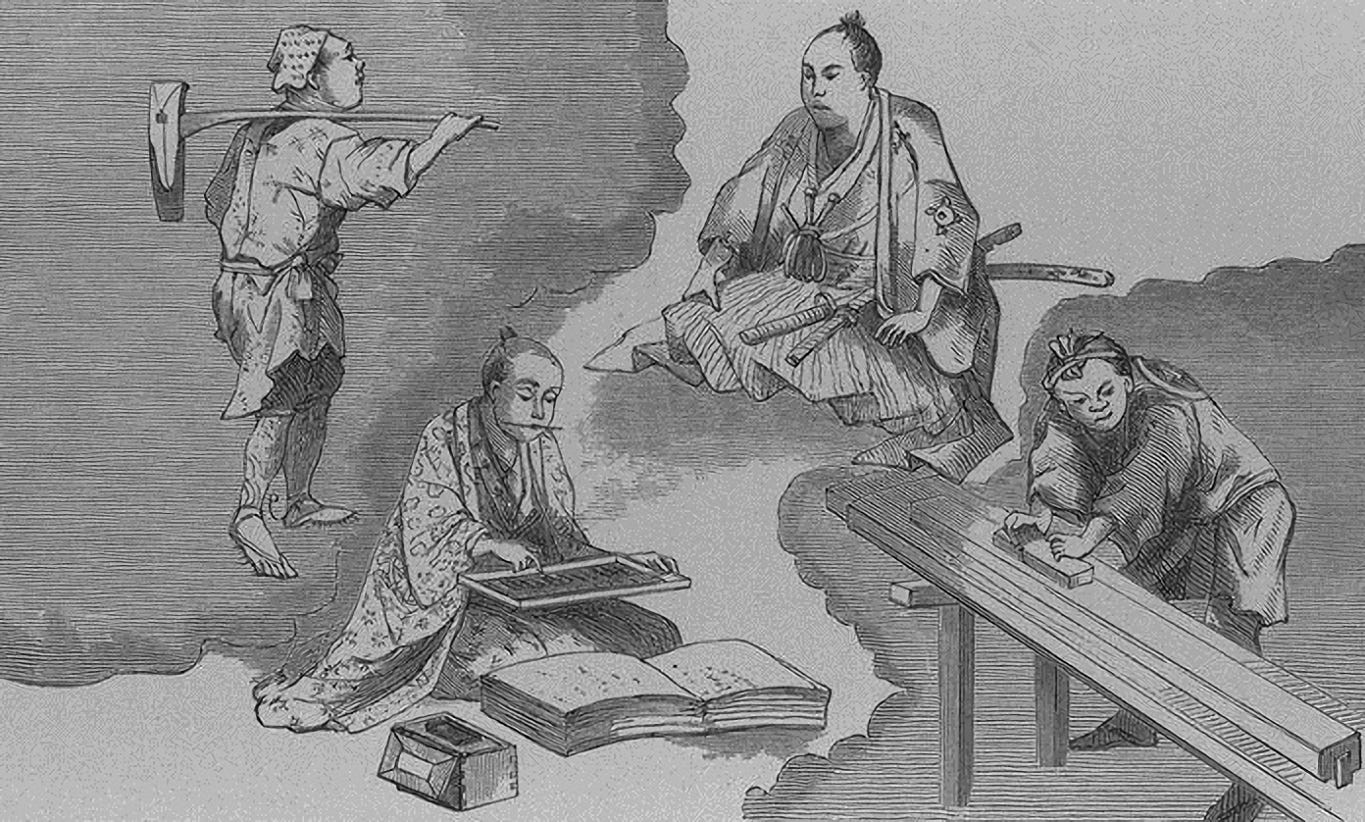

The four occupations system is actually more ancient than Confucius, and it’s plausible that it arose due to a combination of factors such as these: 1) a theory that merchants are less productive than other classes because they just move wealth around instead of producing it; 2) the idea that the virtues of peasants, craftsmen, warriors, or scholars are superior character traits than the cunning and greed of the merchants; and 3) the fact that peasantry and industry are easier to tax and manage by the elite than the mobile, profit-driven merchant class. It seems likely that there was, in ancient China and elsewhere, some sort of elite competition phenomenon, in which the elites who derive their status from other things (nobility, war, religion, philosophy) come up with ways to distinguish themselves from those who became elite solely through the accumulation of wealth, and deny them entry into their ranks.
Similar patterns around elites emerged in very different pre-modern societies. In the Aztec Empire, the pochteca (long-distance traders) became as wealthy as the nobility, but had to hide their riches. In Ancient Rome, the senatorial class was prohibited from engaging in big commercial ventures, and trade was described as “sordidus” (vulgar). In the worst society ever (Sparta), commerce and, indeed, all productive economic activity was deemed unworthy of the citizen elite; they even designed their currency to be impractical so as to discourage the accumulation of wealth.
In other places, trade had a suspect but more normal middle position, as in India (below priests and warriors in the caste system, but above laborers) and in most of medieval Europe (the Christian worldview has traditionally viewed money with suspicion — “it is easier for a camel to go through the eye of a needle than for a rich man to enter the kingdom of God” yadda yadda3). Some societies regarded merchants positively, as in the Islamic world (Muhammad was a trader himself!) and in the city-states of Italy or the Hanseatic League. In the earliest complex civilizations, Mesopotamia and Egypt, trade carried no particular stigma, and long-distance merchants had an important role to play, though one that was embedded into state institutions. But it’s clear that there’s always been a tension between elites-from-wealth and elites-from-other-things, and when the latter wins, the former tends to be associated with ugliness.
Eventually, in the West, the pattern reversed and the elites-from-wealth won. This is essentially the birth of modernity. Starting in the late 18th century, industrialization and liberal revolutions made the bourgeoisie so powerful that it displaced the other elites (the aristocracy and the clergy), and we got our modern liberal-capitalist order. But, three seconds after this happened, Europe invented Romanticism — an artistic and intellectual movement that sacralized nature, elevated authenticity and inner experience as prime values, and came up with the modern conception of the artist as a misunderstood genius who must express his or her inner vision. This was in reaction to the growing importance of commerce and industry, and we basically still live in that world. When my cartoonist friends reacted negatively to the Coca-Cola ad, they were being Romantics.
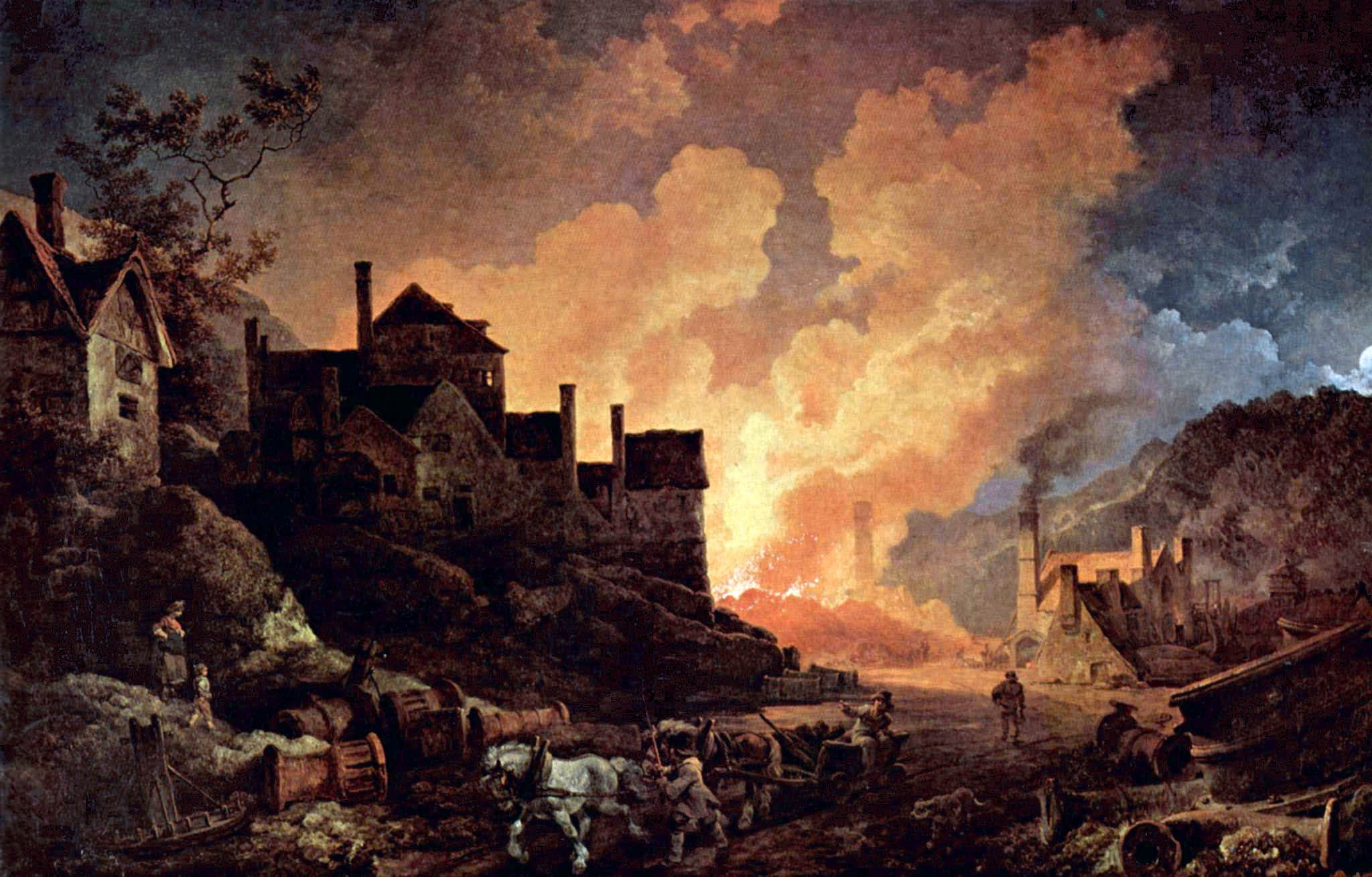
There were also, of course, a lot of political and social reactions to the rise of capitalism. One of these reactions led to Marxism; another took the form of environmentalism. As a result, a lot of people view capitalism in general as at least morally suspect, and at worst a catastrophic scourge on human civilization. It’s hard to view commerce as a thing of beauty when you think that it’s exploiting the workers and/or destroying the planet.
Interestingly, industry, unlike trade, tends to be viewed favorably even by some anti-capitalists, together with agriculture. Consider the hammer and sickle, and more generally the presence of industrial symbols in various socialist-style emblems; a personal favorite is the emblem of North Korea, featuring a hydroelectric plant. Communist symbols seem to have somehow revived the old Confucian prescription that laborers and peasants sit above merchants in the hierarchy of economic activity.

In parallel to these historical explanations, we can come up with more immediate causes to the ugliness of commerce.
Let’s focus on advertisements. Why do we usually not like them? We need not look very far for answers: merely trying to read a recipe on a search-engine-optimized cooking website will provide several. Ads are often overabundant, getting in the way of things we actively want to look at. They can be too big, or mismatched to their context, or repetitive. They may use annoying visual and audio cues (bright colors, tired jingles) to try to hijack our attention. They can be constructed cheaply, with bad design, or the use of temporary materials in the case of physical installations. They can seem insincere, or be downright misleading.
They can be, in sum, the result of poor execution. Just like a work of art in the Romantic sense can be good or bad, an ad can be good or bad, and given the commercial pressure to be profitable, it’s not uncommon for their creators to spend less effort and talent on them than would be aesthetically optimal.
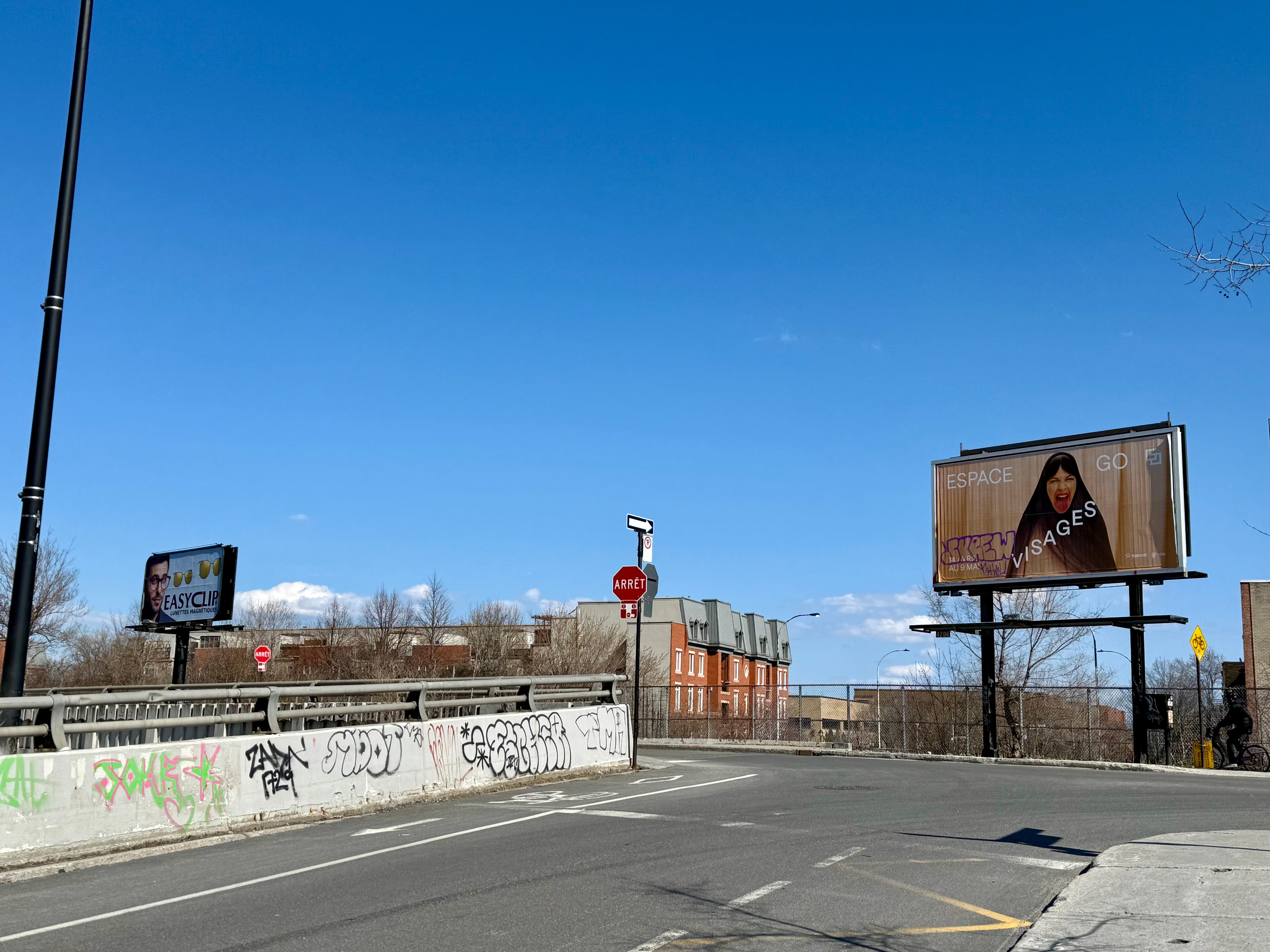
Many of these problems apply to other manifestations of commerce, like the design of stores, or even the behavior of salespeople. Plus, the fact that all of those have some instrumental goal — selling something — rather than “pure” motivations is probably a big part of why we can’t see them as wholesome and beautiful, though that’s the Romantic worldview speaking again.

The interesting thing about the explanations above is that none of them are inherent to commerce or ads. Ads don’t have to be overabundant, mismatched to their environment, or desperately trying to hijack your attention. They don’t have to be dishonest. They can even be pure! And we certainly don’t have to follow Confucian, Romantic, or Marxist ideas to inform how we should think about them.
In fact, I’d argue that most ads and manifestations of commerce are actually well-intentioned, reasonably well executed, and deserving of being thought of as beautiful.
It’s fairly simple to see this, though it requires a little bit of effort. I wrote about this in a January 2024 post: you can learn to modulate your perception of beauty. All you need to do is to focus your attention. Next time you see an ad, take a moment to appreciate the details. Imagine the work that went into the design choices, the typography, the colors, the illustration, the copywriting. Go one step further: think about the product or service being advertised. Think about the energy and time that went into crafting it. It could be a piece of furniture, a theater play, a mortgage brokerage service, whatever — some humans, somewhere, have devoted a lot of their waking hours to make it happen. And then some other humans devoted their hours to make sure that you, and many others, could hear about it.
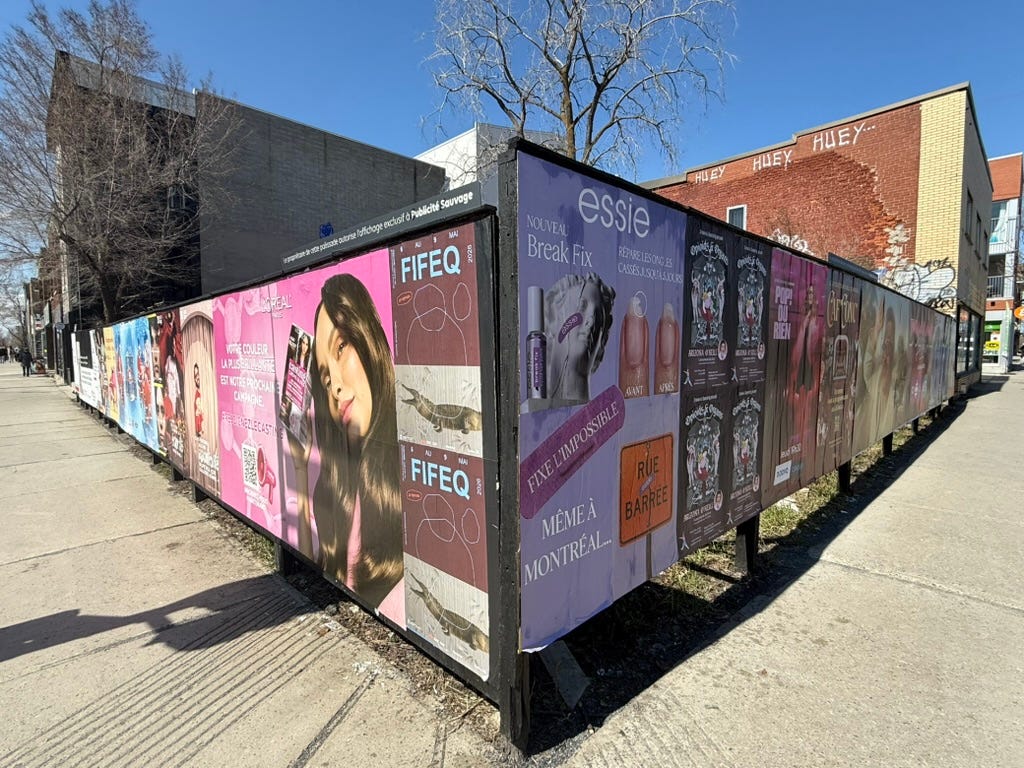
An ad, fundamentally, is an act of communication. It is a message, involving the combined effort of potentially lots of people, meant to inform you that “hey, we made this thing, it means a lot to us, would you consider perhaps buying it if it fits your needs or desires?”
When I take the time to be aware of this, I find it hard to view ads as unpleasant. It doesn’t mean that I look for them, but when, inevitably, they show up in my daily life, it’s very easy for me to feel a wave of aesthetic appreciation, especially if the creative direction is good. Some people poured their hearts into this, and want me to know about it. I don’t know these people, but I like to imagine that they enjoy their jobs, or at least that they are grateful to have them. It becomes easy to imagine that the ad, and the thing being sold, are the output of a labor of love.
Which, yes, is a phrase typically referring to tasks done without expectation of a monetary reward, but… why? There’s nothing wrong with the monetary reward. If you do something out of love and receive money in exchange, it is strictly superior than doing the exact same thing out of love and receiving nothing in exchange. The buyer, of course, spends their money, but unless they were forced to (in which case it’s not commerce), then they were by definition willing to do that. And in many cases, they were probably happy to — it seems true that most people do actually like to spend money in exchange for things they want.4
One reasonable concern might be that adding money into the mix warps the incentives, such that we get the ugly qualities mentioned above. Sure, commerce and ads might be good in isolation, and it’s possible in theory to display them in a tasteful way; but in practice, when you mix things, you get ugliness, like an ad-filled cooking website. I think this happens sometimes, but it’s way less a problem than it seems. We have to take into account that a lot of things wouldn’t exist, or wouldn’t have as much reach, without adding money into the mix! There would be far fewer cooking websites, and far less journalism, sports, magazines, TV shows etc. if these things avoided interacting with the world of commerce. Very often, the alternative to “do something out of love in exchange for money” isn’t “ do it for free”, but “don’t do it at all.” Criticizing a thing for being sullied by commerce, when that’s what allows it to exist in the first place, is just the ugliness of the problem sticking to the solution.
(The one big exception is beautiful environments, whether natural or built. We should not degrade scenic towns and mountains with ads, that much I agree with!)
Besides, all this labor of love is what allows all these people to have money to spend of their own — to spend on things they themselves love, or better yet, on people they love. Or, when things go particularly well, on sacred torii gates for the local place of worship. Economic activity, including industry, agriculture, and, yes, commerce, is what allows us all to live good lives. What could be more beautiful than that?
Of course, none of this will be convincing to people who have already decided they dislike our current economic system. My own skill at noticing beauty in ads and commerce is downstream of realizing, over the course of several years, that liberal capitalism is a pretty elegant way to organize a society. But I do wonder if the causation flowed the other way, too. As I took the time to notice the craft and intentionality in ads and commerce, perhaps I reinforced my emerging belief that capitalism is good and, dare I say, beautiful.
You may not wish for this reframing to happen to you. That’s fine, but I will say this: I find it much better for my happiness to see love and beauty in the ads around me and in the economic system I live in. I suggest you try it! As a bonus, you’ll be immune to the loss of awe and wonder whenever you see a sacred object displaying corporate sponsorships.
An article in La Presse asked similar questions a few days after the start of 2025
What a weird metaphor, when you think about it.
What about poor people? I think they like spending money just as much as anyone else, but they just don’t have much. Giving things to poor people for free is a totally valid way to alleviate poverty, and is what we do in practice, whether through taxes or charity. Ideally, of course, poor people would just stop being poor thanks to having access to economic opportunities in a society with growth.
Most ads are designed to make you feel bad about yourself. They first sell you the problem, and then the solution, but because they want more profit they ensure that that void is never full, so they can keep selling you things. This can feel stupid, but we are more manipulable that we think. You can try to be happier by enjoying the beauty in ads, but the discourse hidden behind will make you feel more empty at the end.
I was flipping through a 1950 ish national geographic and the ads were the most interesting part.